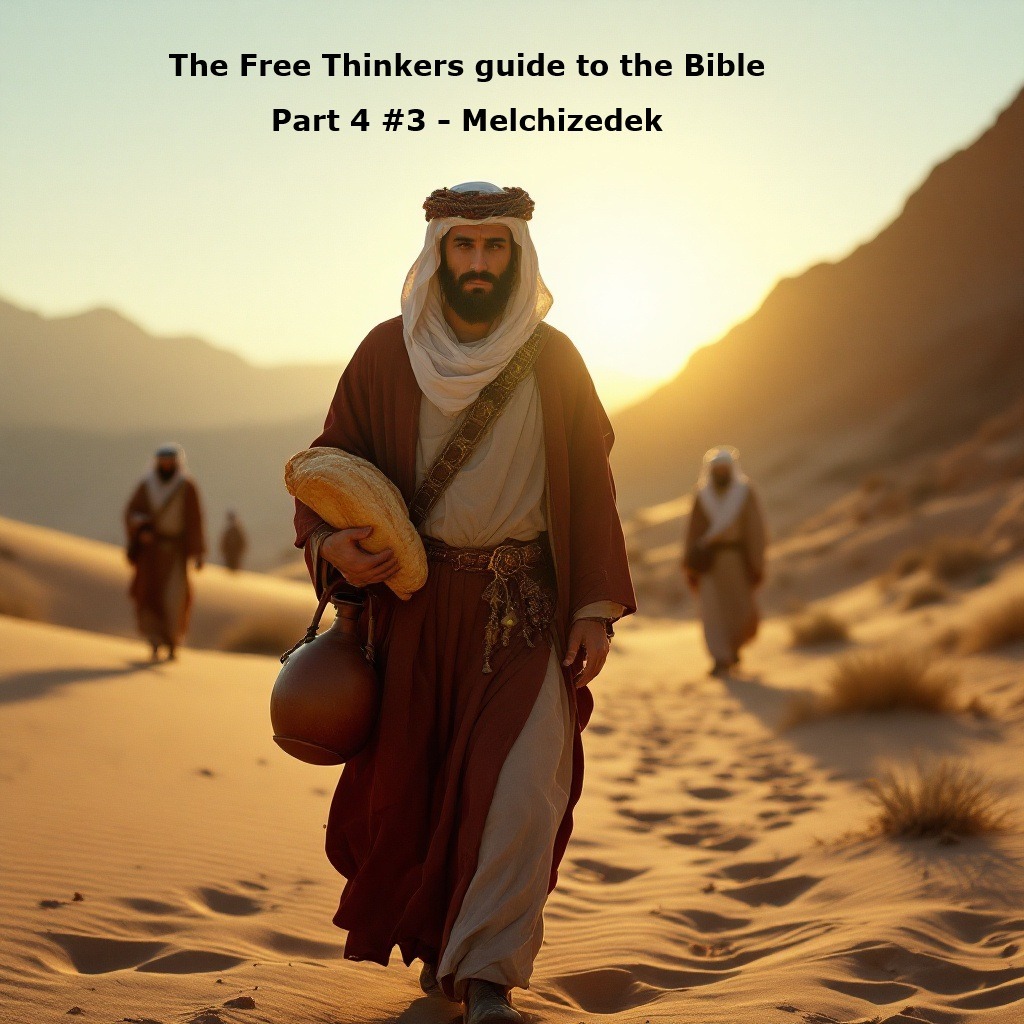
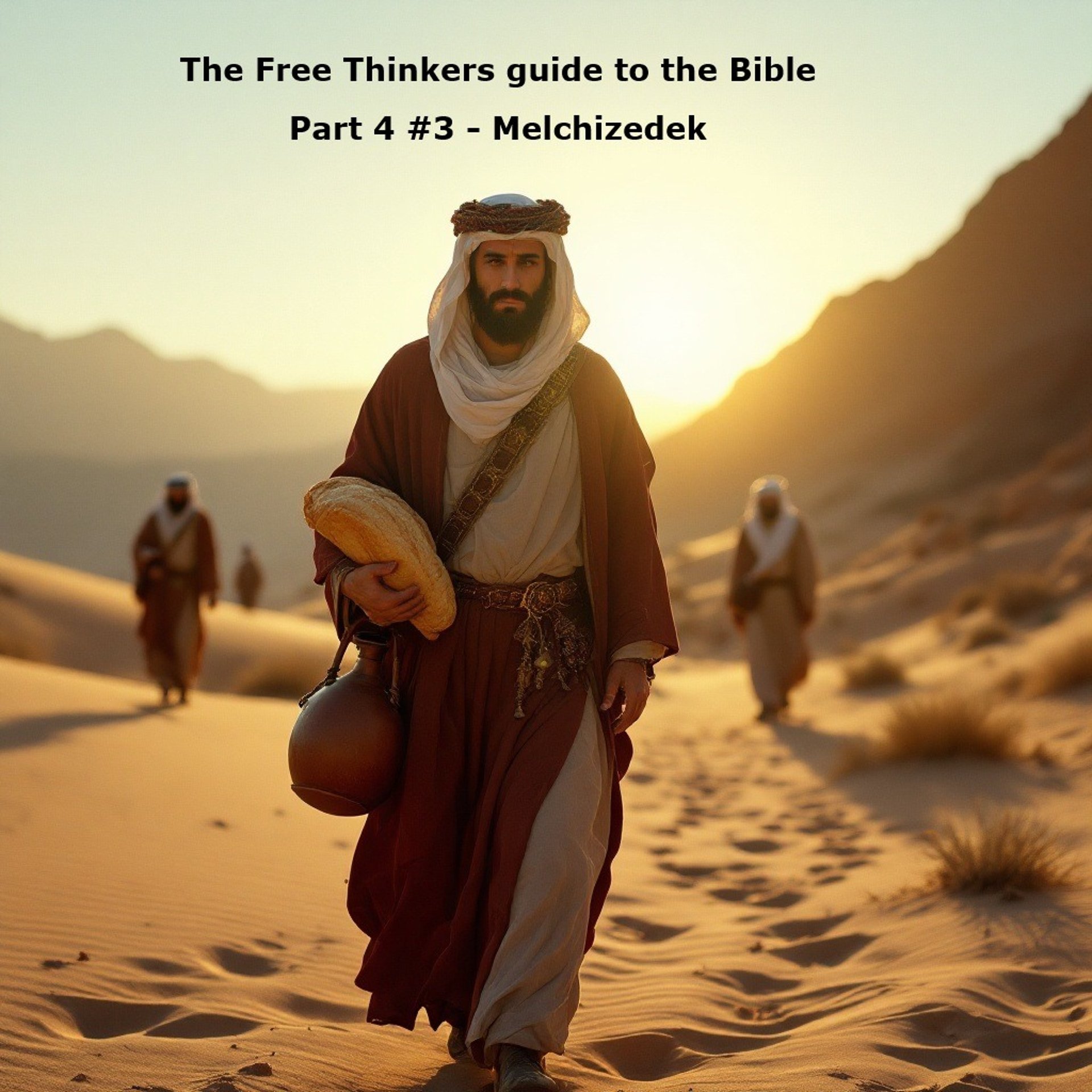

The Free Thinkers guide to the Bible
Part 4 #3 – Melchizedek
The establishment of the Priesthood
Welcome back to the Free Thinkers guide to the bible. I created this series so that ‘anyone’ can explore and understand the bible. You don’t need to be a biblical scholar; all you need is a desire to see what is written. I will present to you several biblical examples and demonstrate the process of sifting the accounts to reveal the hidden. This process is very similar to archeology, where the layers are excavated and analyzed.
Just not the dirty part, though you will be digging up some dirt along the way.
Advisory:
The series unfolds like a story in a book. Please study the content in the order it is presented in order to have the best experience.
The study series begins with Part 1 #1 – The Flood
Preface
In the fourth study we build upon the knowledge we acquired in the first three studies. We have found that there are at least two distinct authors and a superb redactor(s) that created, edited and merged accounts and stories in the books of Genesis, Exodus and Numbers. In the second study we highlighted accounts that diminished or promoted Moses and Aaron. In the third study we highlighted accounts that revealed that the “A” account writer(s) focused on Aaron and priestly matters. The “B” account writer(s) focused on telling stories and made no mention of priestly matters, Aaron was revealed to be a leader of the people and he and Hur were in charge when Moses went up to the Mount.
In this portion of the study we examine the Melchizedek account. We will use the information we gathered in the first three studies to dig deeper and explore the account and look for additions that have been added to further the objectives of the “A” writer(s)/Scribe(s).
Scribal additions are highlighted in orange – ‘which is Zoar’
Key words/repetitions are highlighted in red – ‘The most high God ‘
Abram's war against Chedorlaomer "B"/Melchizedek "A"
Gen 14:1 And it came to pass in the days of Amraphel king of Shinar, Arioch king of Ellasar, Chedorlaomer king of Elam, and Tidal king of nations; 2 That these made war with Bera king of Sodom, and with Birsha king of Gomorrah, Shinab king of Admah, and Shemeber king of Zeboiim, and the king of Bela, (which is Zoar.) 3 All these were joined together in the vale of Siddim, (which is the salt sea.) 4 Twelve years they served Chedorlaomer, and in the thirteenth year they rebelled. 5 And in the fourteenth year came Chedorlaomer, and the kings that were with him, and smote the Rephaims in Ashteroth Karnaim, and the Zuzims in Ham, and the Emims in Shaveh Kiriathaim, 6 And the Horites in their mount Seir, unto Elparan, which is by the wilderness. 7 And they returned, and came to Enmishpat, which is Kadesh, and smote all the country of the Amalekites, and also the Amorites, that dwelt in Hazezontamar.
8 And there went out the king of Sodom, and the king of Gomorrah, and the king of Admah, and the king of Zeboiim, and the king of Bela (the same is Zoar;) and they joined battle with them in the vale of Siddim; 9 With Chedorlaomer the king of Elam, and with Tidal king of nations, and Amraphel king of Shinar, and Arioch king of Ellasar; four kings with five. 10 (And the vale of Siddim was full of slimepits;) and the kings of Sodom and Gomorrah fled, and fell there; and they that remained fled to the mountain. 11 And they took all the goods of Sodom and Gomorrah, and all their victuals, and went their way. 12 And they took Lot, Abram's brother's son, who dwelt in Sodom, and his goods, and departed. 13 And there came one that had escaped, and told Abram the Hebrew; for he dwelt in the plain of Mamre the Amorite, brother of Eshcol, and brother of Aner: and these were confederate with Abram.
14 And when Abram heard that his brother was taken captive, he armed his trained servants, born in his own house, three hundred and eighteen, and pursued them unto Dan. 15 And he divided himself against them, he and his servants, by night, and smote them, and pursued them unto Hobah, (which is on the left hand of Damascus.) 16 And he brought back all the goods, and also brought again his brother Lot, and his goods, and the women also, and the people. 17 And the king of Sodom went out to meet him after his return from the slaughter of Chedorlaomer, and of the kings that were with him, at the valley of Shaveh, (which is the king's dale.)
18 And Melchizedek king of Salem brought forth bread and wine: and he was the priest of the most high God (עֶלְיוֹן אֵל - El El’yon). 19 And he blessed him, and said, blessed be Abram of the most high God (עֶלְיוֹן אֵל - El El’yon), possessor of heaven and earth: 20 and blessed be the most high God (עֶלְיוֹן אֵל - El El’yon), which hath delivered thine enemies into thy hand. And he gave him tithes of all.
21 And the king of Sodom said unto Abram, Give me the persons, and take the goods to thyself. 22 And Abram said to the king of Sodom, I have lift up mine hand unto the LORD (יהוה), the most high God (עֶלְיוֹן אֵל - El El’yon), the possessor of heaven and earth, 23 That I will not take from a thread even to a shoelatchet, and that I will not take any thing that is thine, lest thou shouldest say, I have made Abram rich: 24 Save only that which the young men have eaten, and the portion of the men which went with me, Aner, Eshcol, and Mamre; let them take their portion.
There is something in this account that should give you a niggle in the back of your mind after reading it. The story doesn’t flow. There is something not quite right with it. Is it just over thinking? Or is there a valid issue? The story seems to break when the King of Salem comes into the picture. What if we remove this portion and the scribal notes and then read it?
I present to you the original account with the scribal additions and insertions removed…
14 And when Abram heard that his brother was taken captive, he armed his trained servants, born in his own house, and pursued them unto Dan. 15 And he divided himself against them, he and his servants, by night, and smote them, and pursued them unto Hobah, 16 And he brought back all the goods, and also brought again his brother Lot, and his goods, and the women also, and the people.
17 And the king of Sodom went out to meet him after his return from the slaughter of Chedorlaomer, and of the kings that were with him, at the valley of Shaveh, 21 And the king of Sodom said unto Abram, Give me the persons, and take the goods to thyself. 22 And Abram said to the king of Sodom, I have lift up mine hand unto the LORD (יהוה), 23 That I will not take from a thread even to a shoelatchet, and that I will not take any thing that is thine, lest thou shouldest say, I have made Abram rich: 24 Save only that which the young men have eaten, and the portion of the men which went with me, Aner, Eshcol, and Mamre; let them take their portion.
Summary
With the scribal additions removed the account flows smoothly and reads like a typical “B” account story.
This account has between six and eight scribal insertions. (Highlighted in orange) please review these insertions…
Melchizedek (The King of right(eousness)) is introduced in the account. This King is mentioned only twice in the bible. This account and Psalm 110. A king with such a pedigree should surely have garnered more attention than this. Especially since he is also referred to as being a priest.
Note: This is the first occurrence of priest (kohen) in the bible. And added to that, this King/Priest was said to be the priest of El El’yon! This is also the first occurrence of El El’yon in the bible.
King Melchizedek comes out of nowhere bringing bread and wine to Abram and blesses him. Abram then gives this King/priest of El El’yon a tithe (1/10) of the spoils.
Note: this is the first occurrence of tithing in the bible!
These insertions beg to be questioned for authenticity.
We have the first examples of Priests, tithing and the priest also serving in a leadership role (king). This insertion also contains the first priestly blessing. These references fit perfectly in the “A” writer(s) framework of introducing priestly matters into the biblical accounts.
Word Occurrences/Repetitions:
The most high God – 4X (עֶלְיוֹן אֵל – El El’yon - Mighty Almighty)
Possessor of heaven and earth – 2X
Blessed – 3X
Conclusion
You should definitely be seeing the pattern of evidence at this point in the studies.
The “A” Creation account introduced the seventh day Sabbath and Blessing. (G 1)
The “A” writer(s) then introduced covenant, Clean/unclean animals, the Altar, Olah offerings, a sweet savour, and the prohibition against eating meat with the blood in the Flood account. (G 6-9)
The “A” writer(s) introduce the Priesthood, tithing and priestly authority in this Melchizedek account. (G 14)
We will continue to demonstrate the gradual introduction of priestly matters into the Genesis accounts which pave the way for the Israelite priesthood, its rites, rituals, statutes, laws and judgments.
Please continue with us in the next study:
Part #4 #4 – The Abrahamic covenant
All of the material on this site is the product of my twenty-five years of research and study in the fields of Middle Eastern history, archeology (focusing on the Levant), biblical theology, (the study of the Christian, Judaic and Islamic religions), linguistics (I have studied the Hebrew and Greek languages in order to gain the original writers perspectives). I have personal experience with the following faiths: Southern Baptist, WWCG, CGI, Messianic Judaism and Judaism I lived in a torah based monotheist community based on humanist teachings and values for several years. I have been writing studies/articles and parables since the early 2000s. I published many of my works on the www.YHWHisEl.com site at that time; with a focus on monotheism and the non deity of Jesus (Yehoshua).
After identifying many peculiarities in the TaNaKh while teaching, I tasked myself with determining the source of the inconsistencies. I began my search in the first five books of the bible. I read through them many times, locating inconsistencies and attempting to find the golden key that would unlock them. I read many articles, publications and books in which the authors attempted to explain the irregularities (most based on a version of the JDEP theory) and I tested each against the inconsistencies and all of them failed to provide a viable answer.
I then used critical thinking and tested potential theories until I finally found the solution that solved every problematic area. The Free thinkers guide to the Bible is the culmination of this process.
I only use AI for images on this site; I did not use it to reach my conclusion and I do not use it to write or structure my material. I do not condone AI scraping or any other form of theft of intellectual property.
If you choose to share the information I present; please be courteous and give credit to this site and myself (the author).
Author: Hoyt Allen Spiker - 2024 - Shemoth20@Gmail.com