
YHWH is EL Thoughts on religion
I believe that no one should judge, nor condemn any follower or organization of the Christian or Judaic faiths that adhere to the two greatest principles in the Ten Commands; love the Creator and love your neighbor. We all have more to learn and room to grow in our desire to fulfil these commands.
I believe the Judeo-Christian religions are useful as they tend to promote kindness and solidarity.
The people of Israel whose nation was taken away and were dispersed would never have returned to their land if their identity had evaporated. The Hebrew religion gave the people identity and purpose. The seventh day Sabbath set them apart from the people they lived amongst. Judaism kept the people together with gatherings at synagogues on the Sabbath and the festivals with torah readings at those times.
I condemn religious leaders who seek money and power and use religion as a tool to manipulate people. E. G., 'The Roman Catholic church'
I hope the Free Thinkers series helps you in your studies. I do not present this information to you in order to take away your belief in the Creator. I present the information to help you swipe away the smoke and mirrors that have been intentionally placed before your eyes, so you can clearly see the foundations of the bible and who our Creator is and what He expects from us.
Religions
I would like to give a quick overview of the three Abrahamic faiths:
Judaism is the oldest of the three religions at approx. 3000 years old. It is the tenth largest religion in the world with approx. 15 million adherents. Major sects include Orthodox, Conservative and Reform.
Christianity is the next oldest religion having its beginning approx. 2000 years ago. It has the largest number of adherents, at approx. 2.2 billion. Major sects include Catholic, Protestant and Orthodox.
Islam had its beginning approx.1400 years ago. It has approx. 1.6 billion adherents. Major sects include Sunni, Shia and Sufism.
Thomas Jefferson on religion
I want to share with you the religious beliefs of Thomas Jefferson. He had very interesting views on the subject that were controversial even in his own time. We do this because we believe that the points Mr. Jefferson made many years ago are as valid today as when he was alive.
Thomas Jefferson’s Biography
It is important that you know Mr. Jefferson’s background. I provide you with this very condensed biography.
Mr. Jefferson was born in 1743 and was the third of ten children. During his early childhood he studied Latin, Greek, French, History, Science and the Classics. He was raised in the Episcopalian (Anglican) religion.
At the age of sixteen Jefferson entered the College of William & Mary and became a law clerk for Professor George Wythe. During this time he studied Mathematics, Metaphysics and Philosophy and improved his French and Greek. He completed his coursework in only two years and graduated in 1762.
Jefferson learned a great deal about law while working as a clerk, and due to this he was admitted to the Virginia bar in 1767. He served as a delegate to the Second Continental Congress in 1775. In 1779 he was elected as Governor of Virginia and was re-elected in 1780. He became the U.S. Minister to France in 1785. He served as the first U.S. Secretary of State under President George Washington in 1790. He was elected Vice President in 1796, elected President in 1801 and re-elected President in 1805.
In addition to English, Jefferson could speak and read French, Greek, Italian, Latin and Spanish. At one point his personal library contained over 6,500 books. He was a member of the American Philosophical Society. He was the primary drafter of the Declaration of Independence. While President he authorized the Louisiana Purchase and the building of West Point Academy. He was an architect and founded and designed the University of Virginia. He was also an inventor and farmer.
From this short biography we can ascertain that Mr. Jefferson was extremely intelligent, well read, a quick study, multilingual and had a very diverse set of talents and skills.
Thomas Jefferson’s thoughts on Religion
Mr. Jefferson kept his personal views on religion to himself. The primary sources that we have regarding his thoughts on religion come from his correspondence with friends, family and acquaintances.
In a letter to Peter Carr, dated August 10, 1787 Mr. Jefferson offered his advice on religion. It is important that you read this in its entirety, as it shows in detail how Mr. Jefferson formulated his own thoughts on religion.
“Your reason is now mature enough to examine this object. In the first place divest yourself of all bias in favour of novelty and singularity of opinion. Indulge them in any other subject rather than that of religion. It is too important, and the consequences of error may be too serious. On the other hand shake off all the fears & servile prejudices under which weak minds are servilely crouched. Fix reason firmly in her seat, and call to her tribunal every fact, every opinion. Question with boldness even the existence of a god; because, if there be one, he must more approve of the homage of reason, than that of blindfolded fear. You will naturally examine first the religion of your own country. Read the bible then, as you would read Livy or Tacitus. The facts which are within the ordinary course of nature you will believe on the authority of the writer, as you do those of the same kind in Livy & Tacitus. The testimony of the writer weighs in their favor in one scale, and their not being against the laws of nature does not weigh against them. But those facts in the bible which contradict the laws of nature, must be examined with more care, and under a variety of faces. Here you must recur to the pretensions of the writer to inspiration from god. Examine upon what evidence his pretensions are founded, and whether that evidence is so strong as that its falsehood would be more improbable than a change in the laws of nature in the case he relates. For example, in the book of Joshua we are told the sun stood still several hours. Were we to read that fact in Livy or Tacitus we should class it with their showers of blood, speaking of statues, beasts, &c. But it is said that the writer of that book was inspired. Examine therefore candidly what evidence there is of his having been inspired. The pretension is entitled to your inquiry, because millions believe it. On the other hand, you are astronomer enough to know how contrary it is to the law of nature that a body revolving on its axis as the earth does, should have stopped, should not by that sudden stoppage have prostrated animals, trees, buildings, and should after a certain time have resumed its revolution, & that without a second general prostration. Is this arrest of the earth's motion, or the evidence which affirms it, most within the law of probabilities?
You will next read the new testament. It is the history of a personage called Jesus. Keep in your eye the opposite pretensions of those who say he was begotten by god, born of a virgin, suspended and reversed the laws of nature at will, and ascended bodily into heaven: and of those who say he was a man of illegitimate birth, of a benevolent heart, enthusiastic mind, who set out without pretensions to divinity, ended in believing them, and was punished capitally for sedition by being gibbeted according to the Roman law which punished the first commission of that offence by whipping, and the second by exile or death in furca. See this law in the Digest Lib. 48. tit. 19. 28. 3. & Lipsius Lib. 2. de cruce. cap. 2.
These questions are examined in the books I have mentioned under the head of religion, and several others. They will assist you in your inquiries, but keep your reason firmly on the watch in reading them all. Do not be frightened from this inquiry by any fear of its consequences. If it ends in a belief that there is no god, you will find incitements to virtue in the comfort and pleasantness you feel in its exercise, and the love of others which it will procure you. If you find reason to believe there is a god, a consciousness that you are acting under his eye, and that he approves you, will be a vast additional incitement; if that there be a future state, the hope of a happy existence in that increases the appetite to deserve it; if that Jesus was also a god, you will be comforted by a belief of his aid and love. In fine, I repeat that you must lay aside all prejudice on both sides, & neither believe nor reject anything because any other persons, or description of persons have rejected or believed it. Your own reason is the only oracle given you by heaven, and you are answerable not for the rightness but uprightness of the decision. I forgot to observe when speaking of the new testament that you should read all the histories of Christ, as well of those whom a council of ecclesiastics have decided for us to be Pseudo-evangelists, as those they named Evangelists. Because these Pseudo-evangelists pretended to inspiration as much as the others, and you are to judge their pretensions by your own reason, & not by the reason of those ecclesiastics. Most of these are lost. There are some however still extant, collected by Fabricius which I will endeavor to get & send you.
I never submitted the whole system of my opinions to the creed of any party of men whatever in religion, in philosophy, in politics, or in anything else where I was capable of thinking for myself. Such an addiction is the last degradation of a free and moral agent.
-Thomas Jefferson, letter to Francis Hopkinson, March 13, 1789
Question with boldness even the existence of a god; because if there be one he must approve of the homage of reason more than that of blindfolded fear.
-Thomas Jefferson, letter to Peter Carr, August 10, 1787
Man once surrendering his reason, has no remaining guard against absurdities the most monstrous, and like a ship without rudder, is the sport of every wind.
-Thomas Jefferson to James Smith, 1822.
May it be to the world, what I believe it will be, (to some parts sooner, to others later, but finally to all,) the signal of arousing men to burst the chains under which monkish ignorance and superstition had persuaded them to bind themselves, and to assume the blessings and security of self-government. All eyes are opened, or opening, to the rights of man. The general spread of the light of science has already laid open to every view the palpable truth, that the mass of mankind has not been born with saddles on their backs, nor a favored few booted and spurred, ready to ride them legitimately, by the grace of God.
-Thomas Jefferson, letter to Roger C. Weightman, June 24, 1826 (in the last letter he penned)
On Priests/Priesthood
My opinion is that there would never have been an infidel, if there had never been a priest. The artificial structures they have built on the purest of all moral systems, for the purpose of deriving from it pence and power, revolts those who think for themselves, and who read in that system only what is really there.
-Thomas Jefferson, letter to Mrs. Samuel H. Smith, August, 6, 1816
Millions of innocent men, women and children, since the introduction of Christianity, have been burnt, tortured, fined and imprisoned; yet we have not advanced one inch towards uniformity.
-Thomas Jefferson, Notes on Virginia, 1782
They [the clergy] believe that any portion of power confided to me, will be exerted in opposition to their schemes. And they believe rightly; for I have sworn upon the altar of god, eternal hostility against every form of tyranny over the mind of man. But this is all they have to fear from me: and enough, too, in their opinion.
-Thomas Jefferson to Dr. Benjamin Rush, Sept. 23, 1800
I concur with you strictly in your opinion of the comparative merits of atheism and demonism, and really see nothing but the latter in the being worshipped by many who think themselves Christians.
-Thomas Jefferson, letter to Richard Price, Jan. 8, 1789 (Richard Price had written to TJ on Oct. 26. about the harm done by religion and wrote "Would not Society be better without Such religions? Is Atheism less pernicious than Demonism?")
In every country and in every age, the priest has been hostile to liberty. He is always in alliance with the despot, abetting his abuses in return for protection to his own. it is easier to acquire wealth and power by this combination than by deserving them: and to effect this they have perverted the purest religion ever preached to man, into mystery & jargon unintelligible to all mankind & therefore the safer engine for their purposes.
-Thomas Jefferson, letter to Horatio G. Spafford, March 17, 1814
Priests...dread the advance of science as witches do the approach of daylight and scowl on the fatal harbinger announcing the subversions of the duperies on which they live.
-Thomas Jefferson, Letter to Correa de Serra, April 11, 1820
You say you are a Calvinist. I am not. I am of a sect by myself, as far as I know.
-Thomas Jefferson, letter to Ezra Stiles Ely, June 25, 1819
I can never join Calvin in addressing his god. He was indeed an Atheist, which I can never be; or rather his religion was Daemonism. If ever man worshipped a false god, he did.
-Thomas Jefferson, letter to John Adams, April 11, 1823
Religion and Government
Christianity neither is, nor ever was a part of the common law.
-Thomas Jefferson, letter to Dr. Thomas Cooper, February 10, 1814
Where the preamble declares, that coercion is a departure from the plan of the holy author of our religion, an amendment was proposed by inserting "Jesus Christ," so that it would read "A departure from the plan of Jesus Christ, the holy author of our religion;" the insertion was rejected by the great majority, in proof that they meant to comprehend, within the mantle of its protection, the Jew and the Gentile, the Christian and Mohammedan, the Hindoo and Infidel of every denomination.
-Thomas Jefferson, Autobiography, in reference to the Virginia Act for Religious Freedom
Believing with you that religion is a matter which lies solely between man and his God, that he owes account to none other for his faith or his worship, that the legislative powers of government reach actions only, and not opinions, I contemplate with sovereign reverence that act of the whole American people which declared that their legislature should 'make no law respecting an establishment of religion, or prohibiting the free exercise thereof,' thus building a wall of separation between church and State.
-Thomas Jefferson, letter to Danbury Baptist Association, CT., Jan. 1, 1802
History, I believe, furnishes no example of a priest-ridden people maintaining a free civil government. This marks the lowest grade of ignorance of which their civil as well as religious leaders will always avail themselves for their own purposes.
-Thomas Jefferson to Alexander von Humboldt, Dec. 6, 1813.
Writings/Errors/Doctrines
Ridicule is the only weapon which can be used against unintelligible propositions. Ideas must be distinct before reason can act upon them; and no man ever had a distinct idea of the trinity. It is the mere Abracadabra of the mountebanks calling themselves the priests of Jesus." -Thomas Jefferson, letter to Francis Adrian Van der Kemp, 30 July, 1816
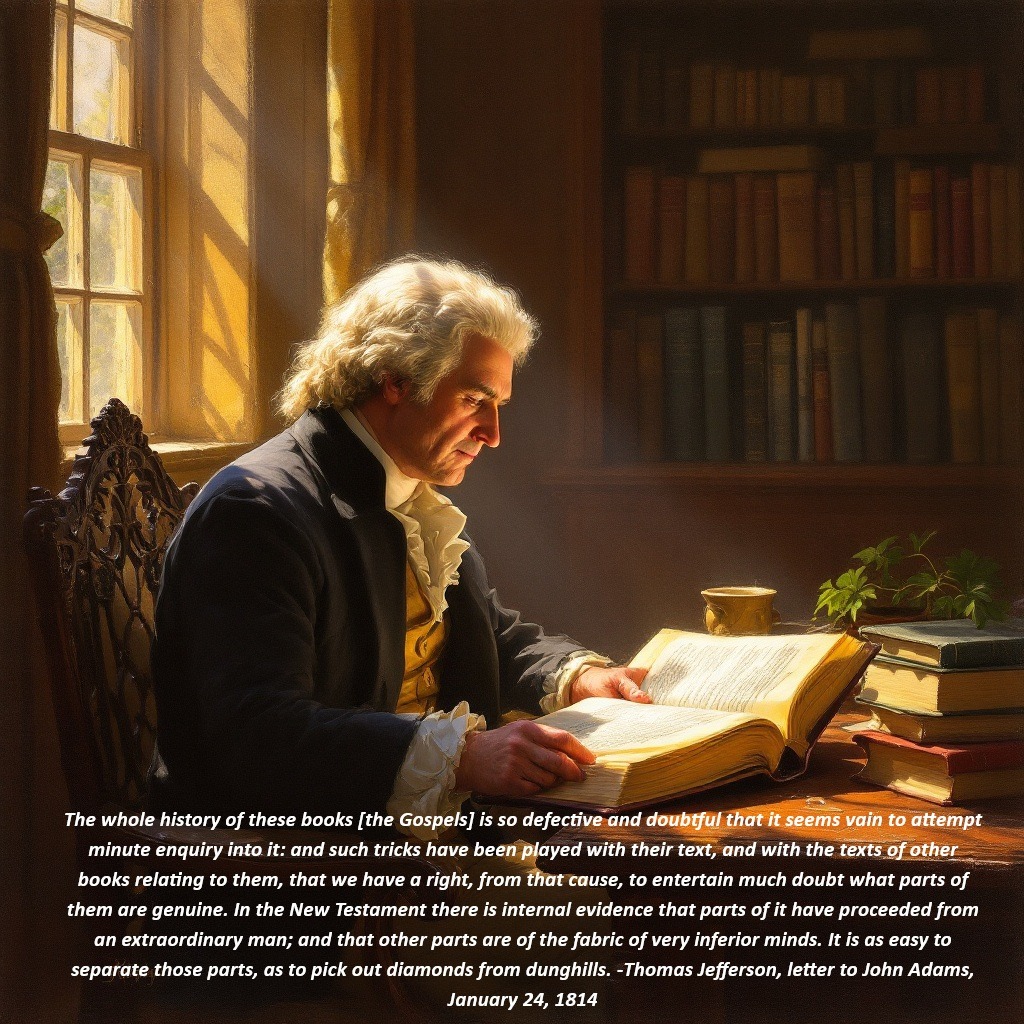
The whole history of these books [the Gospels] is so defective and doubtful that it seems vain to attempt minute enquiry into it: and such tricks have been played with their text, and with the texts of other books relating to them, that we have a right, from that cause, to entertain much doubt what parts of them are genuine. In the New Testament there is internal evidence that parts of it have proceeded from an extraordinary man; and that other parts are of the fabric of very inferior minds. It is as easy to separate those parts, as to pick out diamonds from dunghills. -Thomas Jefferson, letter to John Adams, January 24, 1814
Among the sayings and discourses imputed to him [Jesus] by his biographers, I find many passages of fine imagination, correct morality, and of the most lovely benevolence; and others again of so much ignorance, so much absurdity, so much untruth, charlatanism, and imposture, as to pronounce it impossible that such contradictions should have proceeded from the same being. -Thomas Jefferson, letter to William Short, April 13, 1820
And the day will come when the mystical generation of Jesus, by the supreme being as his father in the womb of a virgin will be classed with the fable of the generation of Minerve in the brain of Jupiter. But may we hope that the dawn of reason and freedom of thought in these United States will do away with this artificial scaffolding, and restore to us the primitive and genuine doctrines of this most venerated reformer of human errors. -Thomas Jefferson, Letter to John Adams, April 11, 1823
To talk of immaterial existences is to talk of nothings. To say that the human soul, angels, god, are immaterial, is to say they are nothings, or that there is no god, no angels, no soul. I cannot reason otherwise: but I believe I am supported in my creed of materialism by Locke, Tracy, and Stewart. At what age of the Christian church this heresy of immaterialism, this masked atheism, crept in, I do not know. But heresy it certainly is. -Thomas Jefferson, letter to John Adams, Aug. 15, 1820
“It is too late in the day for men of sincerity to pretend they believe in the Platonic mysticisms that three are one, and one is three; and yet that the one is not three, and the three are not one . . . But this constitutes the craft, the power and the profit of the priests. Sweep away their gossamer fabrics of factitious religion, and they would catch no more flies. We should all then, like the Quakers, live without an order of priests, moralize for ourselves, follow the oracle of conscience, and say nothing about what no man can understand, nor therefore believe.” --- To John Adams, 1813
“The priests have so disfigured the simple religion of Jesus that no one who reads the sophistications they have engrafted on it, from the jargon of Plato, of Aristotle and other mystics, would conceive these could have been fathered on the sublime preacher of the Sermon on the Mount.” --- To Dr. Waterhouse, 1815
But the greatest of all reformers of the depraved religion of his own country, was Jesus of Nazareth. Abstracting what is really his from the rubbish in which it is buried, easily distinguished by its lustre from the dross of his biographers, and as separable from that as the diamond from the dunghill, we have the outlines of a system of the most sublime morality which has ever fallen from the lips of man. --- To W. Short, Oct. 31, 1819
In the New Testament there is internal evidence that parts of it have proceeded from an extraordinary man; and that other parts are of the fabric of very inferior minds. It is as easy to separate those parts, as to pick out diamonds from dunghills. –- To John Adams, 1804