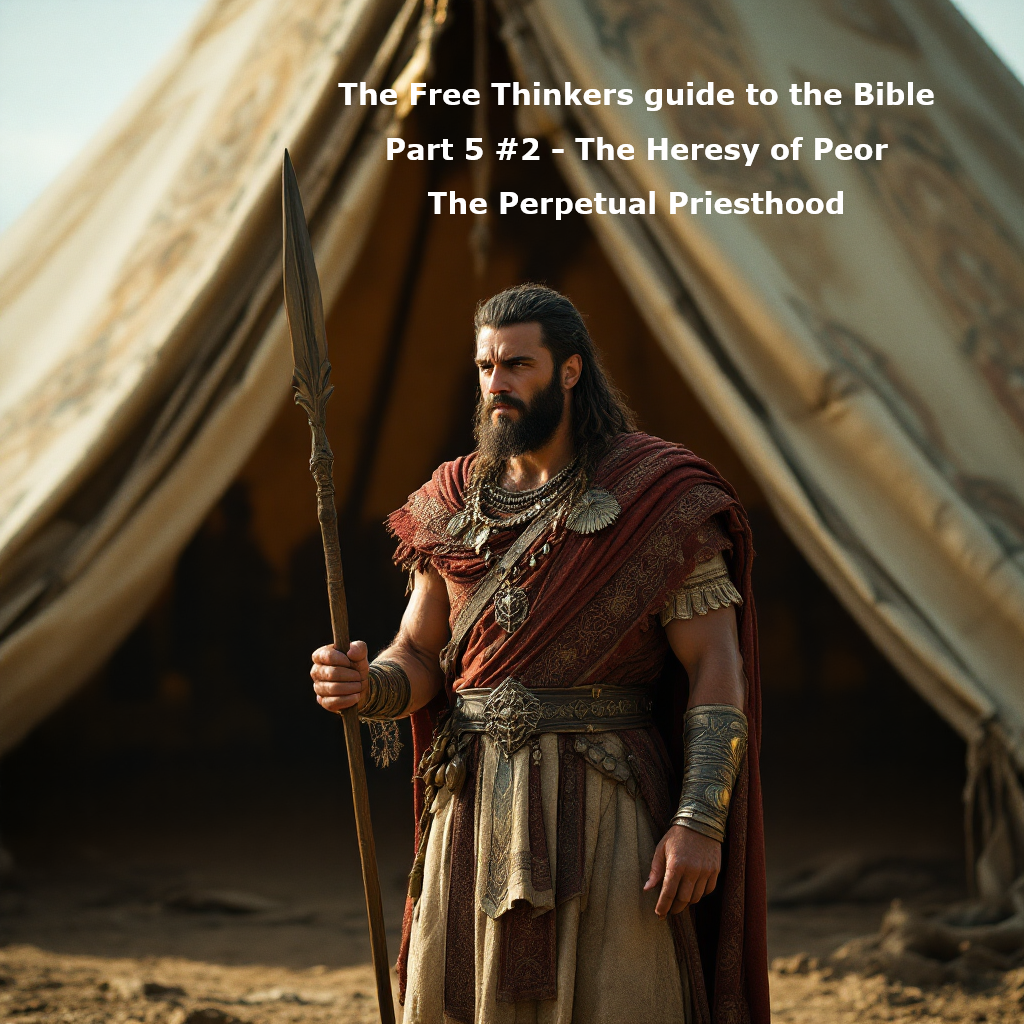
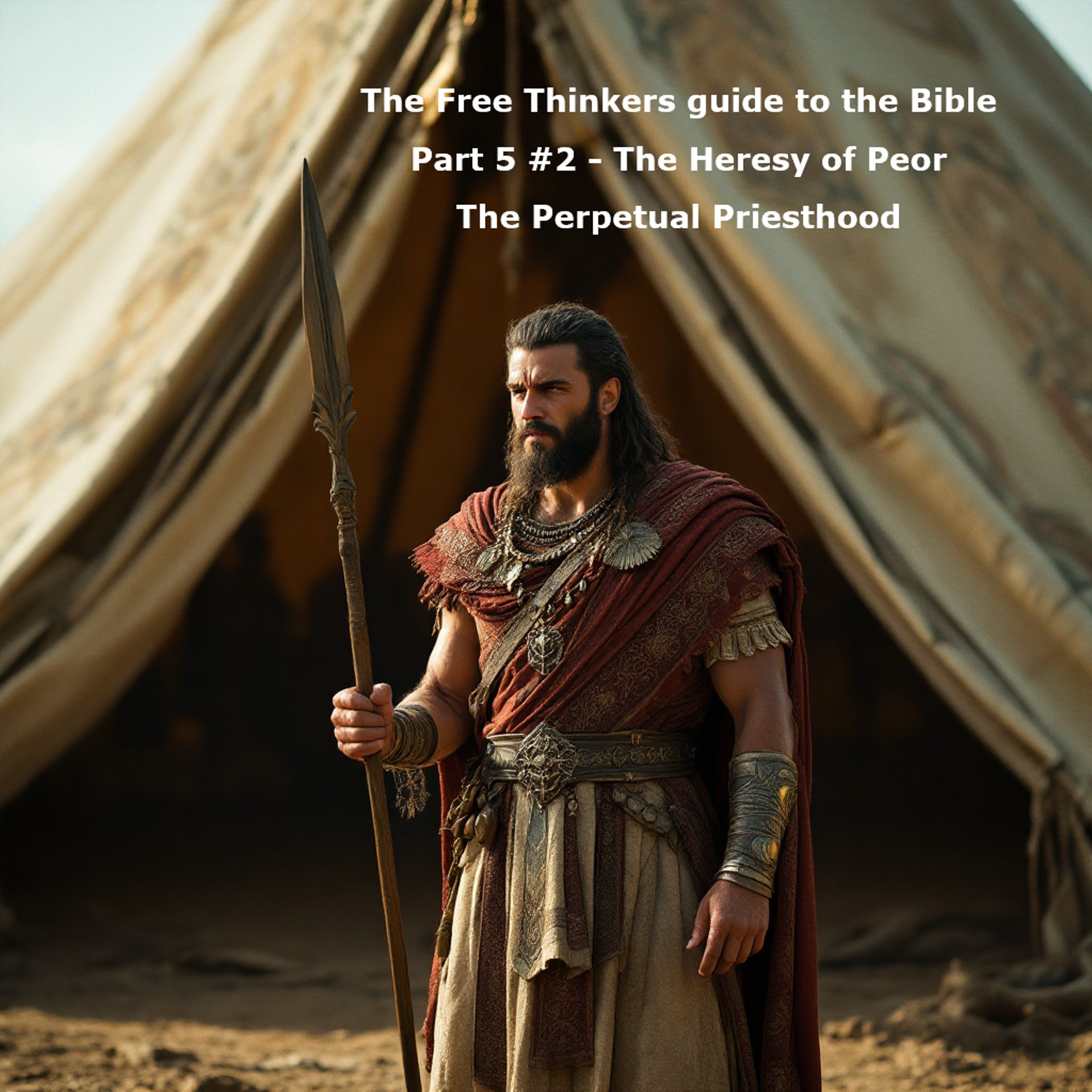

The Free Thinkers guide to the Bible
Part 5 #2 - The covenant of peace
The Perpetual Priesthood
Welcome back to the Free Thinkers guide to the bible. I created this series so that ‘anyone’ can explore and understand the bible. You don’t need to be a biblical scholar; all you need is a desire to see what is written. I will present to you several biblical examples and demonstrate the process of sifting the accounts to reveal the hidden. This process is very similar to archeology, where the layers are excavated and analyzed.
Just not the dirty part, though you will be digging up some dirt along the way.
Advisory:
The series unfolds like a story in a book. Please study the content in the order it is presented in order to have the best experience. The study series begins with Part 1 #1 – The Flood
Preface
Welcome to the fifth portion of the study. In this section we will build upon the knowledge we acquired in the first four studies. The focus of this study will be on the primary goal of the “A” writers; the establishment of the eternal Aaronid priesthood in the hearts and minds of the reader/listener. If you have participated in the series from the beginning you know that the “A” writer’s agenda was to insert the formation of the priesthood with its rites, rituals and statutes. They introduced the Tabernacle of the congregation and the Ark of the Covenant and all of the offerings associated with the priestly worship of the Creator within the “B” writer’s stories. They introduced the Sabbath, the festivals, tithing, clean/unclean foods and the concept of ritually clean/unclean. The Tabernacle was revealed to be the precursor to the House of God built by Solomon the son of David with its altars and ceremonial objects in the Genesis scroll.
*** indicates breaks where verses are used in the “B” writers account
“A” writers keywords/phrases are highlighted in RED
The Heresy of Peor “A”
Numbers 25:6 And, behold, one of the children of Israel came and brought unto his brethren a Midianitish woman in the sight of Moses, and in the sight of all the congregation of the children of Israel, who were weeping before the door of the tabernacle of the congregation.
7 And when Phinehas, the son of Eleazar, the son of Aaron the priest, saw it, he rose up from among the congregation, and took a javelin in his hand; 8 And he went after the man of Israel into the tent, and thrust both of them through, the man of Israel, and the woman through her belly. So the plague was stayed from the children of Israel. 9 And those that died in the plague were twenty and four thousand.
10 And the LORD (יהוה) spake unto Moses, saying, 11 Phinehas, the son of Eleazar, the son of Aaron the priest, hath turned my wrath away from the children of Israel, while he was zealous for my sake among them, that I consumed not the children of Israel in my jealousy.
12 Wherefore say, Behold, I give unto him my covenant of peace: 13 and he shall have it, and his seed after him, even the covenant of an everlasting priesthood; because he was zealous for his God (אלהים) (Elohim), and made an atonement for the children of Israel.
In this third and final sift through this account we will use the information we have learned in the previous studies as our filter. There is a lot of useful information still left for us to examine…
My covenant of peace - B’rit Shalom
We read in verse twelve that the Lord declares that He will give Phinehas His covenant of shalom. We have a few references to this covenant in the old Testament. All but the Phinehas covenant above are located in the writings of the prophets. Our first example is in Isaiah chapter fifty-four.
Isa 54:9 For this is as the waters of Noah unto me: for as I have sworn that the waters of Noah should no more go over the earth; so have I sworn that I would not be wroth with thee, nor rebuke thee. 10 For the mountains shall depart, and the hills be removed; but my kindness shall not depart from thee, neither shall the covenant of my peace be removed, saith the LORD that hath mercy on thee.
Note: Isaiah chapters forty through fifty-five are thought to have been written during the time Israel was exiled in Babylon by an unknown writer/prophet or school of writers/prophets.
Our next examples are from the works attributed to the priest/prophet Ezekiel whose works were written during the Babylonian exile.
Eze 34:25 And I will make with them a covenant of peace, and will cause the evil beasts to cease out of the land: and they shall dwell safely in the wilderness, and sleep in the woods.
Eze 37:25 And they shall dwell in the land that I have given unto Jacob my servant, wherein your fathers have dwelt; and they shall dwell therein, even they, and their children, and their children's children for ever: and my servant David shall be their prince forever. 26 Moreover I will make a covenant of peace with them; it shall be an everlasting covenant with them: and I will place them, and multiply them, and will set my sanctuary in the midst of them for evermore.
Note: According to Jewish tradition the works of Ezekiel were compiled by the Great Assembly (an assembly of scribes and sages that existed during the second Temple period until the early Hellenist period. Prominent members of the Assembly were: Ezra, Nehemiah, Malachi, Haggai, Daniel and Zechariah).
Our final example is in Malachi chapter two. Malachi means ‘my messenger’ in Hebrew and it is widely thought that this is not a proper name. Jewish tradition states that Ezra the Priest and Scribe who was a member of the Great Assembly and who wrote during the Persian period was the actual author of the work. Note the use of ‘messenger’ in the account below…
Malachi 2:4 And ye shall know that I have sent this commandment unto you, that my covenant might be with Levi, saith the LORD of hosts. 5 My covenant was with him of life and peace; and I gave them to him for the fear wherewith he feared me, and was afraid before my name. 6 The law of truth was in his mouth, and iniquity was not found in his lips: he walked with me in peace and equity, and did turn many away from iniquity. 7 For the priest's lips should keep knowledge, and they should seek the law at his mouth: for he is the messenger of the LORD of hosts. 8 But ye are departed out of the way; ye have caused many to stumble at the law; ye have corrupted the covenant of Levi, saith the LORD of hosts. 9 Therefore have I also made you contemptible and base before all the people, according as ye have not kept my ways, but have been partial in the law.
We see in the examples of ‘B’rit Shalom’ that they were all written or thought to have been written during the period of exile in Babylon.
Based on this evidence… was ‘the covenant of shalom’ written in the “A” writers ‘The Heresy of Peor’ account possibly written during the time of the exile by one of the ‘Great Assembly’ scribes or sages?
I leave this for you to ponder…
This will be a good point in our studies to introduce the person who is thought to have written the scrolls of Ezra, Nehemiah (Esdras1&2), Malachi and Chronicles 1&2.
The Ezra connection
Ezra 7:1 Now after these things, in the reign of Artaxerxes king of Persia, Ezra the son of Seraiah, the son of Azariah, the son of Hilkiah, 2 The son of Shallum, the son of Zadok, the son of Ahitub, 3 The son of Amariah, the son of Azariah, the son of Meraioth, 4 The son of Zerahiah, the son of Uzzi, the son of Bukki, 5 The son of Abishua, the son of Phinehas, the son of Eleazar, the son of Aaron the chief priest: 6 This Ezra went up from Babylon; and he was a ready scribe in the law of Moses, which the LORD God of Israel had given: and the king granted him all his request, according to the hand of the LORD his God upon him. 7 And there went up some of the children of Israel, and of the priests, and the Levites, and the singers, and the porters, and the Nethinims, unto Jerusalem, in the seventh year of Artaxerxes the king.
8 And he came to Jerusalem in the fifth month, which was in the seventh year of the king. 9 For upon the first day of the first month began he to go up from Babylon, and on the first day of the fifth month came he to Jerusalem, according to the good hand of his God upon him. 10 For Ezra had prepared his heart to seek the law of the LORD, and to do it, and to teach in Israel statutes and judgments. 11 Now this is the copy of the letter that the king Artaxerxes gave unto Ezra the priest, the scribe, even a scribe of the words of the commandments of the LORD, and of his statutes to Israel.
This introduction of Ezra begins with a genealogy account. We know from our studies that this is a common “A” writer tool to add authority to accounts. According to the genealogy list, Ezra is a descendant of Aaron through the lineage of Eleazar and Phinehas. This lineage grants him the ultimate Aaronid priestly authority. Not only is he an Aaronid priest, he is also a ‘ready’ scribe in the Law of Moses, the commandments of the Lord, the statutes, and judgments! And…
He was also a teacher of the laws, commands, statutes and judgments of the Lord!
Make note that this writer makes extensive use of dates to add authority and validity to the account. We know that this is another tool that is frequently used by the “A” writer(s).
Ask yourself; what person has the credentials that were necessary to compile, modify and redact the scrolls of the Old Testament? What person had access to a team of scribes and sages that could perform the editing of these works?
We return to the account and continue our study…
The everlasting priesthood
We read in the Numbers account that Phinehas was given a second covenant! ‘The covenant of an everlasting priesthood’. The perpetual covenant was already given to his Grandfather Aaron and his descendants during the consecration of Aaron and his sons in Exodus forty…
Exo 40:12 And thou shalt bring Aaron and his sons unto the door of the tabernacle of the congregation, and wash them with water. 13 And thou shalt put upon Aaron the holy garments, and anoint him, and sanctify him; that he may minister unto me in the priest's office. 14 And thou shalt bring his sons, and clothe them with coats: 15 and thou shalt anoint them, as thou didst anoint their father, that they may minister unto me in the priest's office: for their anointing shall surely be an everlasting priesthood throughout their generations.
Aaron and his sons were anointed and given the everlasting priesthood. This would have covered Phinehas as well. The writer was likely re-emphasizing the eternal priesthood and that it was carried on to Phinehas and his descendants.
Phinehas the son of Eleazar
Phinehas is mentioned fifteen times in the Old Testament. We will go through them to determine if there is any information we can gain by studying the references…
Of the fifteen mentions, eight of the mentions add that Phinehas was the son of Eleazar. Adding this to the account adds a degree of transfer of authority from Aaron to Eleazar to Phinehas.
We will begin by reading through the five genealogy accounts…
There are six mentions of Phinehas in genealogy accounts.
Exo 6:25 And Eleazar Aaron's son took him one of the daughters of Putiel to wife; and she bare him Phinehas: these are the heads of the fathers of the Levites according to their families.
1Ch 6:3 And the children of Amram; Aaron, and Moses, and Miriam. The sons also of Aaron; Nadab, and Abihu, Eleazar, and Ithamar. 4 Eleazar begat Phinehas, Phinehas begat Abishua,
1Ch 6:50 And these are the sons of Aaron; Eleazar his son, Phinehas his son, Abishua his son,
1Ch 9:19 And Shallum the son of Kore, the son of Ebiasaph, the son of Korah, and his brethren, of the house of his father, the Korahites, were over the work of the service, keepers of the gates of the tabernacle: and their fathers, being over the host of the LORD, were keepers of the entry. 20 And Phinehas the son of Eleazar was the ruler over them in time past, and the LORD was with him.
Ezra 7:1 Now after these things, in the reign of Artaxerxes king of Persia, Ezra the son of Seraiah, the son of Azariah, the son of Hilkiah, 2 The son of Shallum, the son of Zadok, the son of Ahitub, 3 The son of Amariah, the son of Azariah, the son of Meraioth, 4 The son of Zerahiah, the son of Uzzi, the son of Bukki, 5 The son of Abishua, the son of Phinehas, the son of Eleazar, the son of Aaron the chief priest:
Note: Three of the four genealogy accounts are in Chronicles and Ezra. All accounts associate Phinehas with his father Eleazar.
Note: Abishua the son of Phinehas is mentioned only four times in the Old Testament and all are located in Chronicles and Ezra in genealogy accounts.
We have two mentions of Phinehas in the ‘Heresy of Peor’ account and Psalm 106 declares his heroism at Peor...
Psalm 106:28 They joined themselves also unto Baalpeor, and ate the sacrifices of the dead. 29 Thus they provoked him to anger with their inventions: and the plague brake in upon them. 30 Then stood up Phinehas, and executed judgment: and so the plague was stayed. 31 And that was counted unto him for righteousness unto all generations for evermore.
Phinehas the son of Eleazar the priest was once again pitted against the Midianites in Numbers thirty-one…
Num 31:3 And Moses spake unto the people, saying, Arm some of yourselves unto the war, and let them go against the Midianites, and avenge the LORD of Midian. 4 Of every tribe a thousand, throughout all the tribes of Israel, shall ye send to the war. 5 So there were delivered out of the thousands of Israel, a thousand of every tribe, twelve thousand armed for war. 6 And Moses sent them to the war, a thousand of every tribe, them and Phinehas the son of Eleazar the priest, to the war, with the holy instruments, and the trumpets to blow in his hand. 7 And they warred against the Midianites, as the LORD commanded Moses; and they slew all the males.
Phinehas the son of Eleazar the priest mediated the dispute regarding the altar that was erected by the tribes of Reuben, Gad and Manasseh.
Jos 22:30 And when Phinehas the priest, and the princes of the congregation and heads of the thousands of Israel which were with him, heard the words that the children of Reuben and the children of Gad and the children of Manasseh spake, it pleased them. 31 And Phinehas the son of Eleazar the priest said unto the children of Reuben, and to the children of Gad, and to the children of Manasseh, This day we perceive that the LORD is among us, because ye have not committed this trespass against the LORD: now ye have delivered the children of Israel out of the hand of the LORD. 32 And Phinehas the son of Eleazar the priest, and the princes, returned from the children of Reuben, and from the children of Gad, out of the land of Gilead, unto the land of Canaan, to the children of Israel, and brought them word again.
Phinehas the son of Eleazar buried his father at the end of the scroll of Joshua…
Jos 24:33 And Eleazar the son of Aaron died; and they buried him in a hill that pertained to Phinehas his son, which was given him in mount Ephraim.
And the final mention is in a scribal insertion in the scroll of Judges that stated that Phinehas the son of Eleazar stood before the Ark of the Covenant.
Jdg 20:26 Then all the children of Israel, and all the people, went up, and came unto the house of God, and wept, and sat there before the LORD, and fasted that day until even, and offered burnt offerings and peace offerings before the LORD. 27 And the children of Israel enquired of the LORD, (for the ark of the covenant of God was there in those days, 28 And Phinehas, the son of Eleazar, the son of Aaron, stood before it in those days,) saying, Shall I yet again go out to battle against the children of Benjamin my brother, or shall I cease? And the LORD said, Go up; for tomorrow I will deliver them into thine hand.
Conclusion
We read that there are only three accounts that feature Phinehas the son of Eleazar. The Heresy at Peor which involved the Midianites, The destruction of the Midianites and the mediation at the Altar of Reuben, Gad and Manasseh.
We saw that Phinehas is called ‘Phinehas, the son of Eleazar’ in nine of the fifteen occurrences of his name.
We saw that Phinehas’ son Abishua is only mentioned four times in the Old Testament. All are located in the Genealogies of Ezra the scribe.
We saw a connection between the Covenant of peace in the Numbers account and the writings of Ezra the scribe.
We saw the connections between the “A” writer accounts that use names, dates, and weights in the writings of Ezra the scribe.
We saw the connections between the “A” writer accounts that use genealogies and the writings of Ezra the scribe and his use of genealogies.
I have established a connection for you to use in your studies. Compare what you are reading and look for similarities in writing styles, words, phrases and topics. You may be surprised at how similar most of the “A” writer accounts align with the writings attributed to Ezra...
(Ezra, Malachi, 2nd Ezra which is Nehemiah and Chronicles 1&2)
The “A” writer accounts were likely written by several authors. With practice you can determine with a high degree of accuracy which accounts were written by the master craftsman (Which is most of the accounts and insertions) and those that were written by lesser scribes whose work is of lower quality.
Please continue with us in the next study Part 5 #3 - The for-ever Aaronid priesthood
All of the material on this site is the product of my twenty-five years of research and study in the fields of Middle Eastern history, archeology (focusing on the Levant), biblical theology, (the study of the Christian, Judaic and Islamic religions), linguistics (I have studied the Hebrew and Greek languages in order to gain the original writers perspectives). I have personal experience with the following faiths: Southern Baptist, WWCG, CGI, Messianic Judaism and Judaism I lived in a torah based monotheist community based on humanist teachings and values for several years. I have been writing studies/articles and parables since the early 2000s. I published many of my works on the www.YHWHisEl.com site at that time; with a focus on monotheism and the non deity of Jesus (Yehoshua).
After identifying many peculiarities in the TaNaKh while teaching, I tasked myself with determining the source of the inconsistencies. I began my search in the first five books of the bible. I read through them many times, locating inconsistencies and attempting to find the golden key that would unlock them. I read many articles, publications and books in which the authors attempted to explain the irregularities (most based on a version of the JDEP theory) and I tested each against the inconsistencies and all of them failed to provide a viable answer.
I then used critical thinking and tested potential theories until I finally found the solution that solved every problematic area. The Free thinkers guide to the Bible is the culmination of this process.
I only use AI for images on this site; I did not use it to reach my conclusion and I do not use it to write or structure my material. I do not condone AI scraping or any other form of theft of intellectual property.
If you choose to share the information I present; please be courteous and give credit to this site and myself (the author).
Author: Hoyt Allen Spiker - 2025 - Shemoth20@Gmail.com