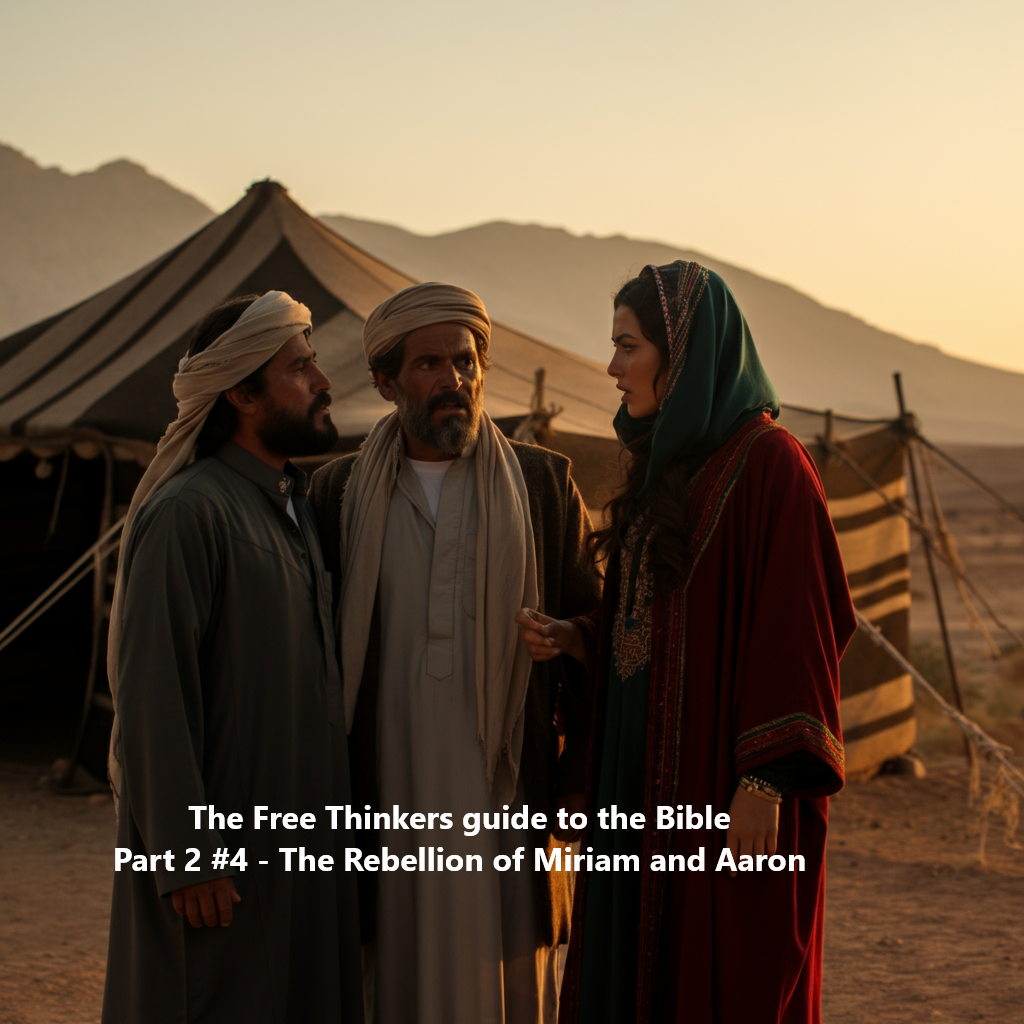
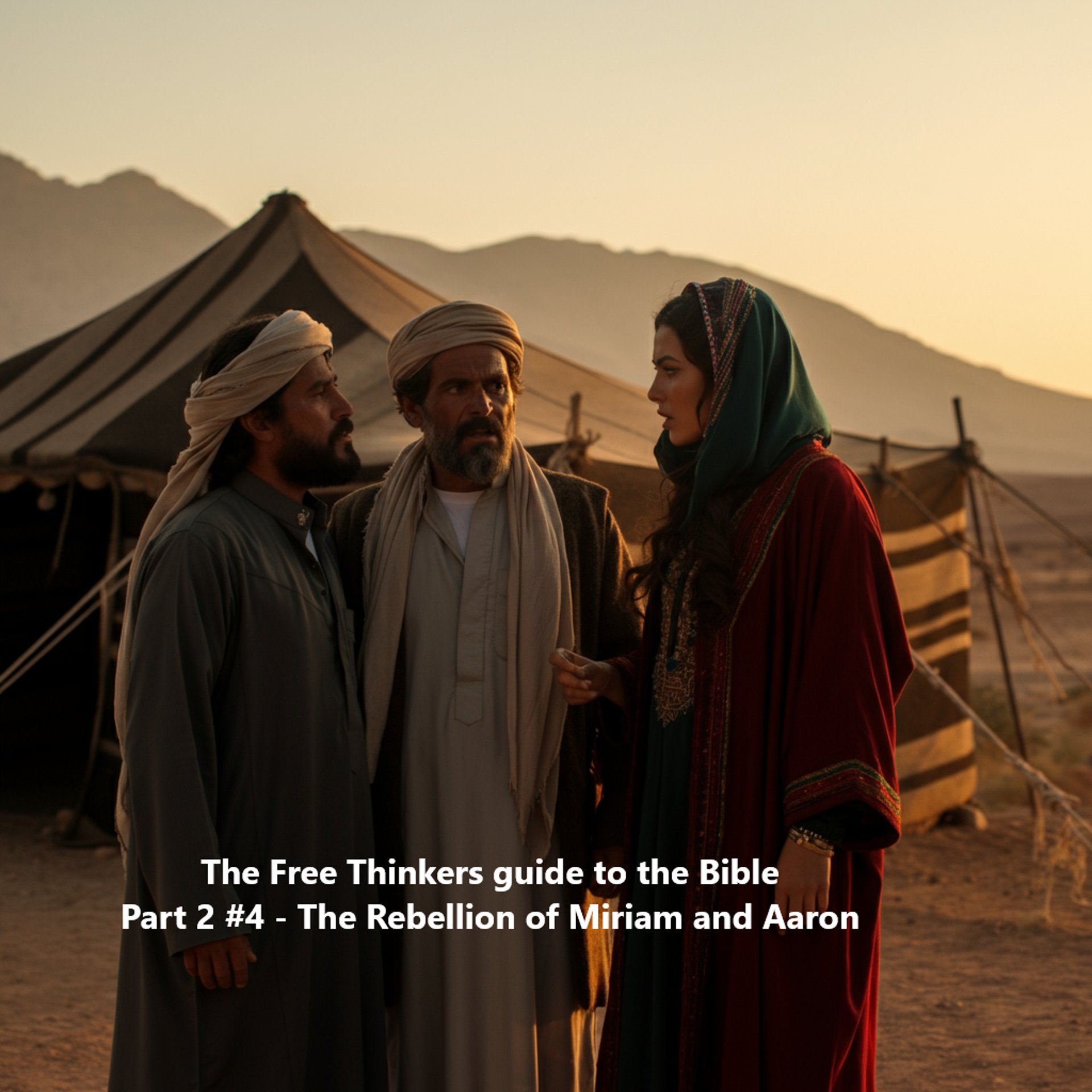

The Free Thinkers guide to the Bible
Part 2 #4 - The Rebellion of Miriam and Aaron
Revealing the veiled battle for Authority
Welcome back to the Free Thinkers guide to the bible. I created this series so that ‘anyone’ can explore and understand the bible. You don’t need to be a biblical scholar; all you need is a desire to see what is written. I will present to you several biblical examples and demonstrate the process of sifting the accounts to reveal the hidden. This process is very similar to archeology, where the layers are excavated and analyzed.
Just not the dirty part, though you will be digging up some dirt along the way.
Warning:
The series unfolds like a story in a book. Please study the content in the order it is presented in order to have the best experience. The study series begins with Part 1 #1 – The Flood
When reading the bible or listening to a Priest, Rabbi or Pastor, have you heard or read contradictions, peculiarities or repetitions that caused your subconscious mind to pause and attempt to reconcile them? Like myself, You may have told yourself “I’m sure there is a reasonable explanation for this”, or “I will look into that later”… more than likely you never got around to it, or decided like the majority of people, that you would trust those with more experience than yourself.
If you are tired of relying on religious authorities to answer the difficult questions with unsatisfying responses that raise more questions than they answer. If you truly seek answers; continue reading the presentations in this series and I will show you how to easily explore the Bible and answer the hard questions yourself.
The series provides you with numerous examples of two distinct groups of scribal authors/redactors.
The first group is the "A" authors/redactors who focus on priestly matters; laws, rules and observances, as well as the tabernacle/temple services and offerings. The "A" authors and writing styles range from literary artisans to unskilled writers whose works are easily identified.
The second group consists of the “B” and “D” author(s)/redactor(s).
The “D” author/redactor chronicles the first person Moses account of the wilderness travels.
The “B” author(s)/redactor(s) wrote the stories in Genesis; Israel’s time in Egypt and the wilderness travels in Exodus and Numbers.
The “B” wilderness accounts harmonize with the “D” author’s first person Moses accounts; and is the reason they are grouped together.
In the study we compare the accounts and explore the differences between them to determine why the "A" priestly authors/redactors intentionally created similar yet separate accounts of many of the “B” author(s)/redactors stories.
In the second part of the series we explore unusual and complex passages that portray Moses and Aaron in diminished or elevated situations. We submit to you that many of these contrasts were deliberately placed in strategic areas to influence the reader.
Before beginning please read Numbers chapter 12
Miriam and Aaron Oppose Moses “B”
Aaron and Miriam diminished
Num 12:1 And Miriam and Aaron spake against Moses because of the Ethiopian woman whom he had married: for he had married an Ethiopian woman.
2 And they said, Hath the LORD indeed spoken only by Moses? hath he not spoken also by us? And the LORD heard it.
3 (Now the man Moses was very meek, above all the men which were upon the face of the earth.)
4 And the LORD spake suddenly unto Moses, and unto Aaron, and unto Miriam, Come out ye three unto the tabernacle of the congregation/Tent of meeting (Ohel Moed). And they three came out. 5 And the LORD came down in the pillar of the cloud, and stood in the door of the tabernacle/Tent (Ohel), and called Aaron and Miriam: and they both came forth. 6 And he said, hear now my words: If there be a prophet among you, I the LORD will make myself known unto him in a vision, and will speak unto him in a dream.
7 My servant Moses is not so, who is faithful in all mine house. 8 With him will I speak mouth to mouth, even apparently, and not in dark speeches; and the similitude of the LORD shall he behold: wherefore then were ye not afraid to speak against my servant Moses? 9 And the anger of the LORD was kindled against them; and he departed.
10 And the cloud departed from off the tabernacle/Tent (Ohel); and, behold, Miriam became leprous, white as snow: and Aaron looked upon Miriam, and, behold, she was leprous. 11 And Aaron said unto Moses, Alas, my lord, I beseech thee, lay not the sin upon us, wherein we have done foolishly, and wherein we have sinned. 12 Let her not be as one dead, of whom the flesh is half consumed when he cometh out of his mother's womb.
13 And Moses cried unto the LORD, saying, Heal her now, O God, I beseech thee. 14 And the LORD said unto Moses, If her father had but spit in her face, should she not be ashamed seven days? let her be shut out from the camp seven days, and after that let her be received in again.
15 And Miriam was shut out from the camp seven days: and the people journeyed not till Miriam was brought in again.
Summary
Aaron and his sister Miriam spoke against Moses’ wife and against his authority as spokesman for the Creator. Miriam is plagued with leprosy for her part in the rebellion. There are no consequences for Aaron written regarding his part in the rebellion beyond an admonishment from the Creator.
Note that Miriam is mentioned before her brother Aaron as speaking out against Moses and was possibly the primary instigator of the speaking out against Moses' wife Tsipporah.
Also note that neither Aaron nor Miriam are referred to as the brother or sister of Moses in this account. This information may seem inconsequential, but future studies will magnify this lack of association with Moses.
Miriam
Miriam is only mentioned fourteen times in the bible. Seven of the instances occur in the rebellion verses.
Exo 15:20 And Miriam the prophetess, the sister of Aaron, took a timbrel in her hand; and all the women went out after her with timbrels and with dances. 21 And Miriam answered them, Sing ye to the LORD, for he hath triumphed gloriously; the horse and his rider hath he thrown into the sea.
We read in the first mention of Miriam in the five books that she is the sister of Aaron and is a prophetess.
(This is the first occurrence of prophetess; and one of only five mentioned in the Old Testament)
The verses do not convey that she is the sister of Moses. Is there a reason for this, or is it just an oversight? There is a high likelihood that these verses were added by an "A" redactor.
A Test for you…
In this observation test; you are tasked with finding the two verses that do not match the “theme” of the laws that are presented in Deuteronomy 24:5-21. When the two verses are removed the account should flow smoothly.
Note: I am using the ISR Scriptures rendering for the test…
Miscellaneous Laws
Deu 24:5 “When a man has taken a new wife, let him not go out into the army nor let any matter be imposed upon him. He shall be exempt one year for the sake of his home, to rejoice with his wife whom he has taken. 6 “No one takes in pledge the lower or the upper millstone, for he would be taking a life in pledge. 7 “When a man is found kidnapping any of his brothers of the children of Yisra’ěl, and treats him harshly or sells him, then that kidnapper shall die. Thus you shall purge the evil from your midst. 8 “Take heed, in an outbreak of leprosy, to diligently guard and do according to all that the priests, the Lěwites, teach you. As I have commanded them, so you shall guard to do. 9 “Remember what יהוה your Elohim did to Miryam on the way when you came out of Mitsrayim. 10 “When you lend your brother a loan, do not go into his house to get his pledge. 11 “Stand outside, and let the man to whom you lend bring the pledge out to you. 12 “And if the man is poor, do not sleep with his pledge. 13 “By all means return the pledge to him at sundown, and he shall sleep in his own garment, and shall bless you. And it shall be righteousness to you before יהוה your Elohim. 14 “Do not oppress a hired servant who is poor and needy, of your brothers or of your strangers who are in your land within your gates. 15 “Give him his wages on the same day, and do not let the sun go down on it, for he is poor and lifts up his being to it, so that he does not cry out against you to יהוה, and it shall be sin in you. 16 “Fathers are not put to death for their children, and children are not put to death for their fathers, each is to die for his own sin. 17 “Do not twist the right-ruling of a stranger or the fatherless, nor take the garment of a widow. 18 “But you shall remember that you were a slave in Mitsrayim, and that יהוה your Elohim ransomed you from there. Therefore I am commanding you to do this word. 19 “When you reap your harvest in your field, and have forgotten a sheaf in the field, do not go back to get it. Let it be for the stranger, for the fatherless, and for the widow, so that יהוה your Elohim might bless you in all the work of your hands. 20 “When you beat your olive trees, do not examine the branch behind you. Let it be for the stranger, for the fatherless, and for the widow. 21 “When you gather the grapes of your vineyard, do not glean behind you. Let it be for the stranger, for the fatherless, and for the widow.
Miscellaneous Laws - with additions removed
Deu 24:5 “When a man has taken a new wife, let him not go out into the army nor let any matter be imposed upon him. He shall be exempt one year for the sake of his home, to rejoice with his wife whom he has taken. 6 “No one takes in pledge the lower or the upper millstone, for he would be taking a life in pledge. 7 “When a man is found kidnapping any of his brothers of the children of Yisra’ěl, and treats him harshly or sells him, then that kidnapper shall die. Thus you shall purge the evil from your midst. *** 10 “When you lend your brother a loan, do not go into his house to get his pledge. 11 “Stand outside, and let the man to whom you lend bring the pledge out to you. 12 “And if the man is poor, do not sleep with his pledge. 13 “By all means return the pledge to him at sundown, and he shall sleep in his own garment, and shall bless you. And it shall be righteousness to you before יהוה your Elohim.
The account flows smoothly with the added verses removed. The verses focus on "A" writer subjects; leprosy and that the Creator had commanded the priests and Levites to teach the people to 'guard and do' (2X) all of the rites associated with the containment and cure of leprosy. They also tasked the people with 'remembering' that the Creator gave Miriam leprosy.
Please continue the series with Part 2 #5 The heresy of Peor
All of the material on this site is the product of my twenty-five years of research and study in the fields of Middle Eastern history, archeology (focusing on the Levant), biblical theology, (the study of the Christian, Judaic and Islamic religions), linguistics (I have studied the Hebrew and Greek languages in order to gain the original writers perspectives). I have personal experience with the following faiths: Southern Baptist, WWCG, CGI, Messianic Judaism and Judaism I lived in a torah based monotheist community based on humanist teachings and values for several years. I have been writing studies/articles and parables since the early 2000s. I published many of my works on the www.YHWHisEl.com site at that time; with a focus on monotheism and the non deity of Jesus (Yehoshua).
After identifying many peculiarities in the TaNaKh while teaching, I tasked myself with determining the source of the inconsistencies. I began my search in the first five books of the bible. I read through them many times, locating inconsistencies and attempting to find the golden key that would unlock them. I read many articles, publications and books in which the authors attempted to explain the irregularities (most based on a version of the JDEP theory) and I tested each against the inconsistencies and all of them failed to provide a viable answer.
I then used critical thinking and tested potential theories until I finally found the solution that solved every problematic area. The Free thinkers guide to the Bible is the culmination of this process.
I only use AI for images on this site; I did not use it to reach my conclusion and I do not use it to write or structure my material.
I do not condone AI scraping or any other form of theft of intellectual property.
If you choose to share the information I present; please be courteous and give credit to this site and myself (the author).
Author: Hoyt Allen Spiker - 2024 - Shemoth20@Gmail.com