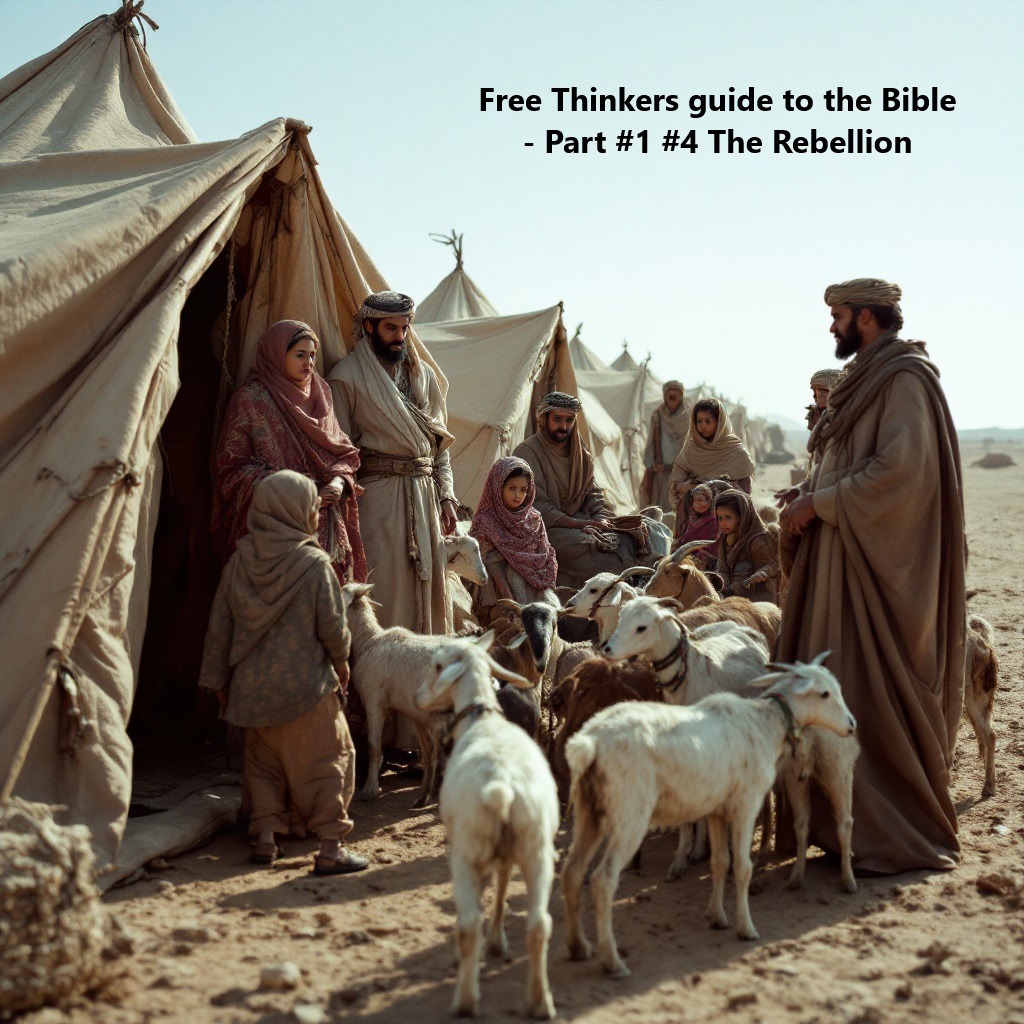
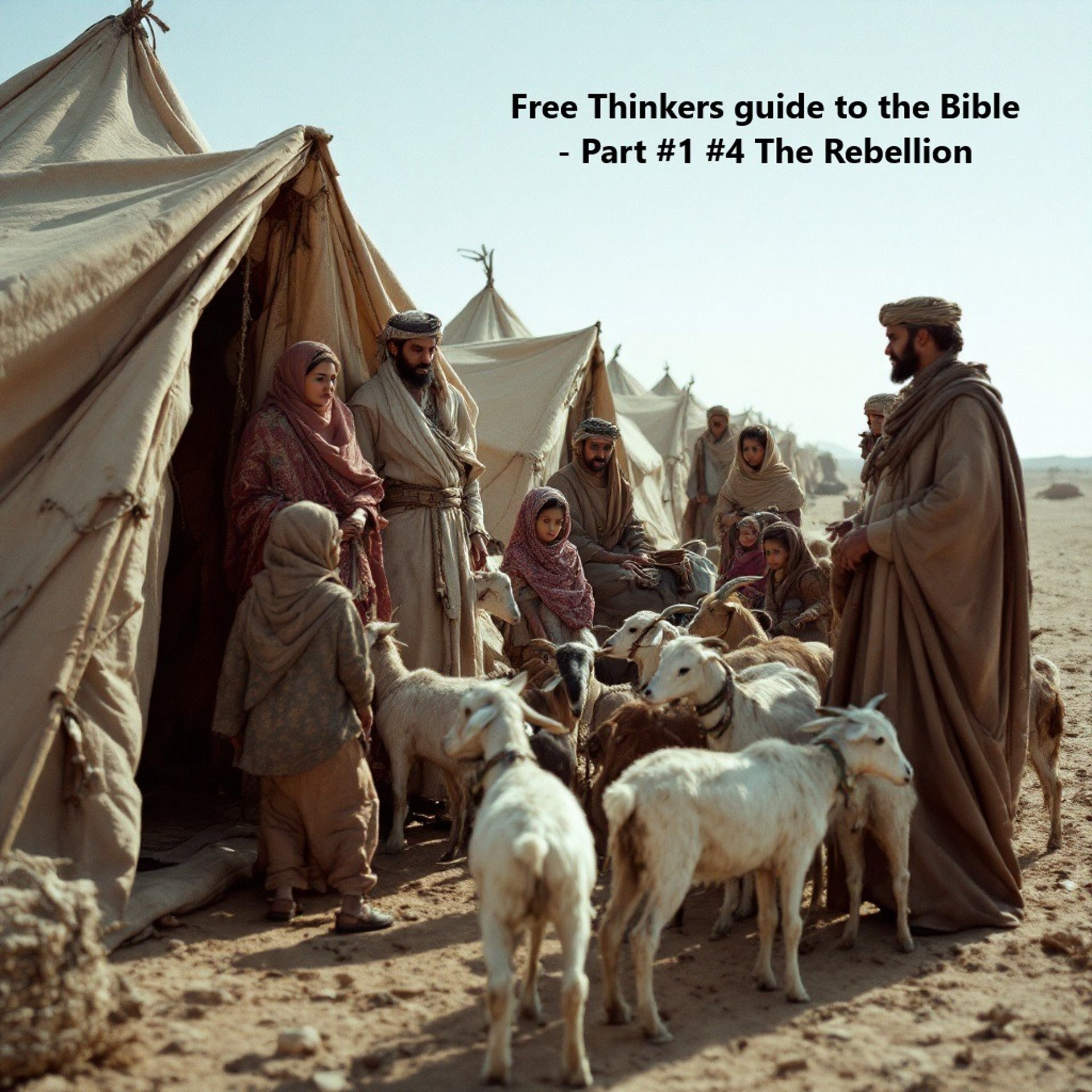

The Free Thinkers guide to the Bible
Part 1 #4 - The Rebellion
Welcome back to the Free Thinkers guide to the bible. I created this series so that ‘anyone’ can explore and understand the bible. You don’t need to be a biblical scholar; all you need is a desire to see what is written. I will present to you several biblical examples and demonstrate the process of sifting the accounts to reveal the hidden. This process is very similar to archeology, where the layers are excavated and analyzed. Just not the dirty part, though you will be digging up some dirt along the way.
Warning:
The series unfolds like a story in a book. Please study the content in the order it is presented in order to have the best experience. The study series begins with Part 1 #1 – The Flood
The series provides you with numerous examples of two distinct groups of scribal authors/redactors.
The first group is the "A" authors/redactors who focus on priestly matters; laws, rules and observances, as well as the tabernacle/temple services and offerings. The "A" authors and writing styles range from literary artisans to unskilled writers whose works are easily identified.
The second group consists of the “B” and “D” author(s)/redactor(s).
The “D” author/redactor chronicles the first person Moses account of the wilderness travels.
The “B” author(s)/redactor(s) wrote the stories in Genesis; Israel’s time in Egypt and the wilderness travels in Exodus and Numbers.
The “B” wilderness accounts harmonize with the “D” author’s first person Moses accounts; and is the reason they are grouped together.
In the study we compare the accounts and explore the differences between them to determine why the "A" priestly authors/redactors intentionally created similar yet separate accounts of many of the “B” author(s)/redactors stories.
The Rebellion – Two accounts interwoven
Preface
Have you ever read the Rebellion account and got the feeling that the story was disjointed and difficult to follow? Did you just shrug it off, or tell yourself you would look into it later?
This study will be an examination of the well known story of The Rebellion. If you are like me, you will have a few questions in the back of your mind after reading it.
Let’s begin the process of revealing the hidden.
Before beginning, read Numbers chapters 16, Look for anything out of the ordinary and Jot down any questions that come to mind.
We will go through the biblical account and identify areas that should be investigated. This exercise will give you practice in spotting anomalies in future studies and when you read portions of the bible that are not covered in this series. Also look for word and subject repetitions.
We continue our study in the book of Numbers. This portion of the study will be mind opening, and of course will bring more questions to mind.
Observation one
Two different reasons for questioning authority
Num 16:1 Now Korah, the son of Izhar, the son of Kohath, the son of Levi, and Dathan and Abiram, the sons of Eliab, and On, the son of Peleth, sons of Reuben, took men: 2 And they rose up before Moses, with certain of the children of Israel, two hundred and fifty princes of the assembly, famous in the congregation, men of renown: 3 And they gathered themselves together against Moses and against Aaron, and said unto them, Ye take too much upon you, seeing all the congregation are holy, every one of them, and the Lord (יהוה) is among them: wherefore then lift ye up yourselves above the congregation of the Lord (יהוה)?
This Rebellion centers around a Levite, Korach with two-hundred and fifty leaders of the Levites with Dathan and Abiram who rise up against Moses and Aaron stating that they are as “holy” as Moses and Aaron, and should also be able to serve as Priests.
Num 16:12 And Moses sent to call Dathan and Abiram, the sons of Eliab: which said, We will not come up: 13 Is it a small thing that thou hast brought us up out of a land that floweth with milk and honey, to kill us in the wilderness, except thou make thyself altogether a prince over us? 14 Moreover thou hast not brought us into a land that floweth with milk and honey, or given us inheritance of fields and vineyards: wilt thou put out the eyes of these men?
This Rebellion centers on Dathan and Abiram with the recurring theme of ‘the people grumble because they haven’t reached the “Promised” Land’. They also rise up against Moses and challenge his authority over them.
We see that there are two separate rebellions involving Korach, Dathan and Abiram.
Observation two
Two different consequences
In this observation we identify that there are two different consequences for those rising up against the authority.
Num 16:25 And Moses rose up and went unto Dathan and Abiram; and the elders of Israel followed him. 26 And he spake unto the congregation, saying, Depart, I pray you, from the tents of these wicked men, and touch nothing of theirs, lest ye be consumed in all their sins. 27 So they gat up from the tabernacle of Korah, Dathan, and Abiram, on every side: and Dathan and Abiram came out, and stood in the door of their tents, and their wives, and their sons, and their little children. 28 And Moses said, Hereby ye shall know that the Lord (יהוה) hath sent me to do all these works; for I have not done them of mine own mind. 29 If these men die the common death of all men, or if they be visited after the visitation of all men; then the Lord (יהוה) hath not sent me. 30 But if the Lord (יהוה) make a new thing, and the earth open her mouth, and swallow them up, with all that appertain unto them, and they go down quick into the pit; then ye shall understand that these men have provoked the Lord (יהוה). 31 And it came to pass, as he had made an end of speaking all these words, that the ground clave asunder that was under them: 32 and the earth opened her mouth, and swallowed them up, and their houses, and all the men that appertained unto Korah, and all their goods. 33 They, and all that appertained to them, went down alive into the pit, and the earth closed upon them: and they perished from among the congregation.
This consequence results in the earth swallowing the people and all of their possessions.
Num 16:35 And there came out a fire from the Lord (יהוה), and consumed the two hundred and fifty men that offered incense.
This consequence oddly occurs directly after the earth swallowed the people and their possessions.
We see that there are two separate rebellions against authority. One involves Levite/Priestly authority; the other involves the authority of Moses over the people. We must ask why there is a separate consequence for the two-hundred and fifty Levite leaders that does not apply to Korach, Dathan and Abiram.
The Answer
We have compiled enough valid questions to solve the mystery. Based on our observations we should know that there is one logical explanation. Similar to the Flood account, someone skillfully combined two very different stories into a single account.
I will now provide you with two separate accounts to examine. This should ensure that the questions we posed earlier are satisfactorily answered.
One story, two accounts intermixed
The Levite Rebellion priestly account “A”
Numbers 16:1a Now Korah, the son of Izhar, the son of Kohath, the son of Levi, and two hundred and fifty princes of the assembly, famous in the congregation, men of renown.
***3 And they gathered themselves together against Moses and against Aaron, and said unto them, Ye take too much upon you, seeing all the congregation are holy, every one of them, and the Lord (יהוה) is among them: wherefore then lift ye up yourselves above the congregation of the Lord (יהוה)? 4 And when Moses heard it, he fell upon his face: 5 and he spake unto Korah and unto all his company, saying, Even tomorrow the Lord (יהוה) will shew who are his, and who is holy; and will cause him to come near unto him: even him whom he hath chosen will he cause to come near unto him. 6 This do; Take you censers, Korah, and all his company; 7 And put fire therein, and put incense in them before the Lord (יהוה) tomorrow: and it shall be that the man whom the Lord (יהוה) doth choose, he shall be holy: ye take too much upon you, ye sons of Levi. 8 And Moses said unto Korah, Hear, I pray you, ye sons of Levi: 9 Seemeth it but a small thing unto you, that the God (אלהים) (Elohim) of Israel hath separated you from the congregation of Israel, to bring you near to himself to do the service of the tabernacle of the Lord (יהוה), and to stand before the congregation to minister unto them? 10 And he hath brought thee near to him, and all thy brethren the sons of Levi with thee: and seek ye the priesthood also? 11 For which cause both thou and all thy company are gathered together against the Lord (יהוה): and what is Aaron, that ye murmur against him?
***16 And Moses said unto Korah, Be thou and all thy company before the Lord (יהוה), thou, and they, and Aaron, tomorrow: 17 and take every man his censer, and put incense in them, and bring ye before the Lord (יהוה) every man his censer, two hundred and fifty censers; thou also, and Aaron, each of you his censer. 18 And they took every man his censer, and put fire in them, and laid incense thereon, and stood in the door of the tabernacle of the congregation with Moses and Aaron. 19 And Korah gathered all the congregation against them unto the door of the tabernacle of the congregation: and the glory of the Lord (יהוה) appeared unto all the congregation. 20 And the Lord (יהוה) spake unto Moses and unto Aaron, saying, 21 Separate yourselves from among this congregation, that I may consume them in a moment. 22 And they fell upon their faces, and said, O God (אל), the God (אלהים) of the spirits of all flesh, shall one man sin, and wilt thou be wroth with all the congregation?
***35 And there came out a fire from the Lord (יהוה), and consumed the two hundred and fifty men that offered incense. (Through the end of the chapter)
In this Rebellion account Korach and two-hundred and fifty Levite leaders rise up against Moses and Aaron stating that they equally deserve to serve the Creator in the Priestly capacity. (Dathan and Abiram are not present in the account because they are not Levites and are unable to serve in the Priestly capacity).
They gather with the people at the tabernacle of the congregation and offer incense. Fire consumes the two-hundred and fifty Levites. The leader Korach, is not mentioned as being consumed by the fire in the account. Moses and Aaron intercede on the people’s behalf and place the blame squarely on Korach and ask that the congregation be spared from his guilt.
One story, two accounts intermixed
The Rebellion of Dathan, Abiram and On - account “B”
Numbers 16:1b and Dathan and Abiram, the sons of Eliab, and On, the son of Peleth, sons of Reuben, took men: 2 and they rose up before Moses, ***12 And Moses sent to call Dathan and Abiram, the sons of Eliab: which said, We will not come up: 13 Is it a small thing that thou hast brought us up out of a land that floweth with milk and honey, to kill us in the wilderness, except thou make thyself altogether a prince over us? 14 Moreover thou hast not brought us into a land that floweth with milk and honey, or given us inheritance of fields and vineyards: wilt thou put out the eyes of these men? We will not come up. 15 And Moses was very wroth, and said unto the Lord (יהוה), Respect not thou their offering: I have not taken one ass from them, neither have I hurt one of them.
***23 And the Lord (יהוה) spake unto Moses, saying, 24 Speak unto the congregation, saying, Get you up from about the tabernacle (dwelling place) of (Korah), Dathan, and Abiram. 25 And Moses rose up and went unto Dathan and Abiram; and the elders of Israel followed him. 26 And he spake unto the congregation, saying, Depart, I pray you, from the tents of these wicked men, and touch nothing of theirs, lest ye be consumed in all their sins. 27 So they gat up from the tabernacle (dwelling place) of (Korah), Dathan, and Abiram, on every side: And Dathan and Abiram came out, and stood in the door of their tents, and their wives, and their sons, and their little children. 28 And Moses said, Hereby ye shall know that the Lord (יהוה) hath sent me to do all these works; for I have not done them of mine own mind. 29 If these men die the common death of all men, or if they be visited after the visitation of all men; then the Lord (יהוה) hath not sent me. 30 But if the Lord (יהוה) make a new thing, and the earth open her mouth, and swallow them up, with all that belongs unto them, and they go down quick into the pit; then ye shall understand that these men have provoked the Lord (יהוה). 31 And it came to pass, as he had made an end of speaking all these words, that the ground clave asunder that was under them: 32 and the earth opened her mouth, and swallowed them up, and their houses, and all the men that appertained unto (them?) Korah, and all their goods. 33 They, and all that belonged to them, went down alive into the pit, and the earth closed upon them: and they perished from among the congregation. 34 And all Israel that were round about them fled at the cry of them: for they said, Lest the earth swallow us up also.
In this rebellion account Dathan, Abiram and On (who is not mentioned after this) rise up against Moses leadership and complain that they have still not made it to the new lands “that flow with milk and honey” and also complain because they don’t want to die in the Wilderness. (Korach is not a part of this rebellion, though the writer would have you believe that he was by inserting his name in three locations).
In verse 24 Moses tells the congregation to remove themselves from around the tents of Korach, Dathan and Abiram. In the next verse Moses went only to the tents of Dathan and Abiram (Korach’s tent is not mentioned).
In verse 27 it states that the people moved away from the tents of Korach, Dathan and Abiram. We then read that only Dathan and Abiram came out of their tents and stood at the doorway. (Once again Korach is not mentioned).
In verse 32 the writer cleverly inserts Korach’s name and asserts that Korach and his family and possessions shared the same fate as Dathan and Abiram. (This fate is refuted by several biblical accounts which I will cite below)
Comparison and Examination
The first Rebellion account centers around a Levite, Korach and two-hundred and fifty (Levite) leaders of the people who rise up against Moses and Aaron stating that they are as “holy” as Moses and Aaron, and should be able to serve as Priests as well. Moses devises a test in which Aaron, Korach and the leaders would come to the “Tent of meeting” and offer incense and the Creator would decide who would be worthy to serve Him. The “glory” of YHWH appeared to all the people and the result is that Korach and the leaders are consumed by fire.
The second Rebellion account centers on the recurring theme of ‘the people grumble because they haven’t reached the “Promised” Land’. They rise up against Moses and challenge his authority over them. Moses goes to the tents of the leaders of the rebellion and the Creator makes them an example to the people.
Summary
When compared to the Waters of Meribah study we see clear similarities in writing styles. We see one writer is focused on Aaron and the Priesthood, the other is focused on Moses. One writer tells a story of rebellion against the authority and leadership of Moses, the other is focused on the rebellion against the authority and priesthood of Aaron. Both accounts have consequences for those who challenged their authority.
Note: It appears that the author; or a redactor inserted the name of Korach in several places to help integrate the two accounts.
I will give two examples to help further develop this probability.
The writer of the Priesthood rebellion later writes…
Num 26:9 And the sons of Eliab; Nemuel, and Dathan, and Abiram. This is that Dathan and Abiram, which were famous in the congregation, who strove against Moses and against Aaron in the company of Korah, when they strove against the Lord (יהוה): 10 And the earth opened her mouth, and swallowed them up together with Korah, when that company died, what time the fire devoured two hundred and fifty men: and they became a sign. 11 Notwithstanding the children of Korah died not.
The “A” writer doubles down on their assertion that Korach was swallowed up with Dathan and Abiram. They attempt to cover up the problem that Korach’s children were not swallowed up, because they lived and continued serving as Levites, the Korahite line continued to serve in the Temple during the time of Solomon. One example of this is in 1 Chronicles 9…
1Ch 9:19 And Shallum the son of Kore, the son of Ebiasaph, the son of Korah, and his brethren, of the house of his father, the Korahites, were over the work of the service, keepers of the gates of the tabernacle: and their fathers, being over the host of the Lord (יהוה), were keepers of the entry.
We find in chapter eleven of Deuteronomy a confirmation of the “B” writers account. We read that Dathan and Abiram were used as an example. Korach is not mentioned at all in the example or the book of Deuteronomy.
Deu 11:6 and what He had done to Dathan and Aḇiram the sons of Eliyaḇ, son of Re’uḇěn, when the earth opened its mouth and swallowed them up, and their households, and their tents, and all the living creatures that were in their possession, in the midst of all Yisra’ěl.
I continue to expand on this information in the future studies:
If you wish to continue exploring and seek greater understanding, please continue with the next study:
All of the material on this site is the product of my twenty-five years of research and study in the fields of Middle Eastern history, archeology (focusing on the Levant), biblical theology, (the study of the Christian, Judaic and Islamic religions), linguistics (I have studied the Hebrew and Greek languages in order to gain the original writers perspectives). I have personal experience with the following faiths: Southern Baptist, WWCG, CGI, Messianic Judaism and Judaism I lived in a torah based monotheist community based on humanist teachings and values for several years. I have been writing studies/articles and parables since the early 2000s. I published many of my works on the www.YHWHisEl.com site at that time; with a focus on monotheism and the non deity of Jesus (Yehoshua).
After identifying many peculiarities in the TaNaKh while teaching, I tasked myself with determining the source of the inconsistencies. I began my search in the first five books of the bible. I read through them many times, locating inconsistencies and attempting to find the golden key that would unlock them. I read many articles, publications and books in which the authors attempted to explain the irregularities (most based on a version of the JDEP theory) and I tested each against the inconsistencies and all of them failed to provide a viable answer.
I then used critical thinking and tested potential theories until I finally found the solution that solved every problematic area. The Free thinkers guide to the Bible is the culmination of this process.
I only use AI for images on this site; I did not use it to reach my conclusion and I do not use it to write or structure my material. I do not condone AI scraping or any other form of theft of intellectual property.
If you choose to share the information I present; please be courteous and give credit to this site and myself (the author).
Author: Hoyt Allen Spiker - 2024 - Shemoth20@Gmail.com