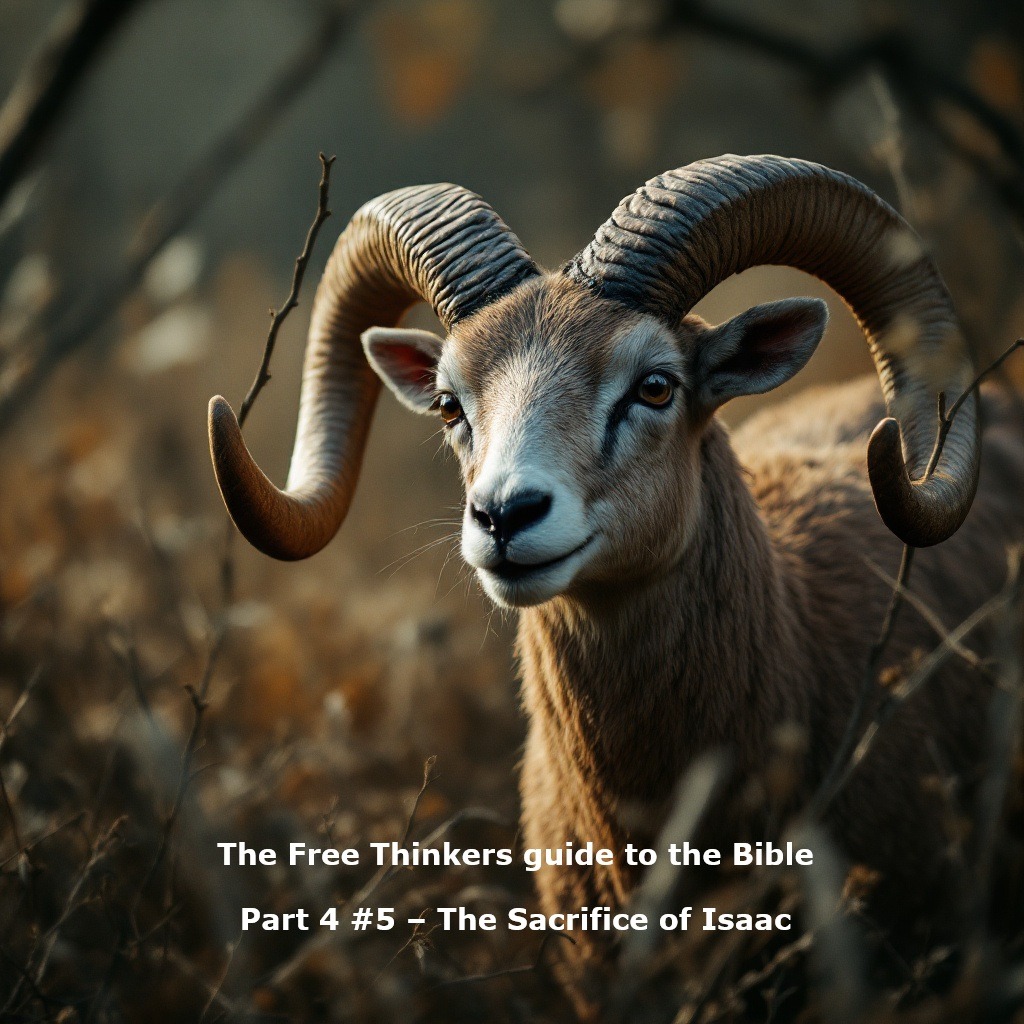

The Free Thinkers guide to the Bible
Part 4 #5 – The Sacrifice of Isaac
The establishment of the Priesthood
Highlighted priestly rituals “Burnt offering and Altar”
Welcome back to the Free Thinkers guide to the bible. I created this series so that ‘anyone’ can explore and understand the bible. You don’t need to be a biblical scholar; all you need is a desire to see what is written. I will present to you biblical examples and demonstrate the process of sifting the accounts to reveal the hidden. This process is very similar to archeology, where the layers are excavated and analyzed.
Just not the dirty part, though you will be digging up some dirt along the way.
Advisory:
The series unfolds like a story in a book. Please study the content in the order it is presented in order to have the best experience. The study series begins with Part 1 #1 – The Flood
Preface
In the fourth study we build upon the knowledge we acquired in the first three studies. We have found that there are at least two distinct authors and a superb redactor(s) that created, edited and merged accounts and stories in the books of Genesis, Exodus, Numbers and Deuteronomy. In the second study we highlighted accounts that diminished or promoted Moses and Aaron. In the third study we highlighted accounts that revealed that the “A” account writer(s) focused on Aaron and priestly matters. The “B” account writer(s) focused on telling stories and made no mention of priestly matters, Aaron was revealed to be a leader of the people and he and Hur were in charge when Moses went up to the Mount.
In this portion of the study we examine the “The sacrifice of Isaac” account. We will use the information we gathered in the first three studies to explore the areas that require close examination.
The Sacrifice of Isaac "A"
Gen 22:1 And it came to pass after these things, that God did tempt Abraham, and said unto him, Abraham: and he said, Behold, here I am. 2 And he said, Take now thy son, thine only son Isaac, whom thou lovest, and get thee into the land of Moriah; and offer him there for a burnt offering upon one of the mountains which I will tell thee of. 3 And Abraham rose up early in the morning, and saddled his ass, and took two of his young men with him, and Isaac his son, and clave the wood for the burnt offering, and rose up, and went unto the place of which God had told him. 4 Then on the third day Abraham lifted up his eyes, and saw the place afar off. 5 And Abraham said unto his young men, Abide ye here with the ass; and I and the lad will go yonder and worship (שׁחה - shâchâh), and come again to you. 6 And Abraham took the wood of the burnt offering, and laid it upon Isaac his son; and he took the fire in his hand, and a knife; and they went both of them together.
7 And Isaac spake unto Abraham his father, and said, my father: and he said, here am I, my son. And he said, behold the fire and the wood: but where is the lamb for a burnt offering? 8 And Abraham said, my son, God will provide himself a lamb for a burnt offering: so they went both of them together. 9 And they came to the place which God had told him of; and Abraham built an altar there, and laid the wood in order, and bound Isaac his son, and laid him on the altar upon the wood.
10 And Abraham stretched forth his hand, and took the knife to slay his son. 11 And the angel of the LORD called unto him out of heaven, and said, Abraham, Abraham: and he said, Here am I. 12 And he said, Lay not thine hand upon the lad, neither do thou anything unto him: for now I know that thou fearest God, seeing thou hast not withheld thy son, thine only son from me. 13 And Abraham lifted up his eyes, and looked, and behold behind him a ram caught in a thicket by his horns: and Abraham went and took the ram, and offered him up for a burnt offering in the stead of his son.
14 And Abraham called the name of that place Jehovahjireh: as it is said to this day, in the mount of the LORD it shall be seen.
15 And the angel of the LORD called unto Abraham out of heaven the second time, 16 And said, By myself have I sworn, saith the LORD, for because thou hast done this thing, and hast not withheld thy son, thine only son: 17 That in blessing I will bless thee, and in multiplying I will multiply thy seed as the stars of the heaven, and as the sand which is upon the sea shore; and thy seed shall possess the gate of his enemies; 18 And in thy seed shall all the nations of the earth be blessed; because thou hast obeyed my voice. 19 So Abraham returned unto his young men, and they rose up and went together to Beersheba; and Abraham dwelt at Beersheba.
Summary
This “A” account tells the story of God testing Abraham by telling him to take his son Isaac (the son of his old age) and offer him up as an Olah offering.
We have six references to Burnt offering in the account (Olah – ascension offering (figuratively steps or stairs – This was a voluntary offering that was performed by the priesthood when a person wanted to draw closer to the Creator).
Note: The Olah offering is referred to in only two Genesis accounts “The Flood” account and this account.
I present to you the Olah offering ritual in Leviticus with the common priestly “A” writers key words highlighted in red for your review…
The Olah offering/sacrifice
Lev 1:1 And the LORD called unto Moses, and spake unto him out of the tabernacle of the congregation, saying, 2 Speak unto the children of Israel, and say unto them, If any man of you bring an offering unto the LORD, ye shall bring your offering of the cattle, even of the herd, and of the flock. 3 If his offering be a burnt sacrifice (עולה - ‛ôlâh) of the herd, let him offer a male without blemish: he shall offer it of his own voluntary will at the door of the tabernacle of the congregation before the LORD. 4 And he shall put his hand upon the head of the burnt offering (עולה - ‛ôlâh); and it shall be accepted for him to make atonement for him. 5 And he shall kill the bullock before the LORD: and the priests, Aaron's sons, shall bring the blood, and sprinkle the blood round about upon the altar that is by the door of the tabernacle of the congregation. 6 And he shall flay the burnt offering (עולה - ‛ôlâh), and cut it into his pieces. 7 And the sons of Aaron the priest shall put fire upon the altar, and lay the wood in order upon the fire: 8 And the priests, Aaron's sons, shall lay the parts, the head, and the fat, in order upon the wood that is on the fire which is upon the altar: 9 But his inwards and his legs shall he wash in water: and the priest shall burn all on the altar, to be a burnt sacrifice (עולה - ‛ôlâh), an offering made by fire, of a sweet savour unto the LORD.
10 And if his offering be of the flocks, namely, of the sheep, or of the goats, for a burnt sacrifice (עולה - ‛ôlâh); he shall bring it a male without blemish. 11 And he shall kill it on the side of the altar northward before the LORD: and the priests, Aaron's sons, shall sprinkle his blood round about upon the altar. 12 And he shall cut it into his pieces, with his head and his fat: and the priest shall lay them in order on the wood that is on the fire which is upon the altar: 13 But he shall wash the inwards and the legs with water: and the priest shall bring it all, and burn it upon the altar: it is a burnt sacrifice (עולה - ‛ôlâh), an offering made by fire, of a sweet savour unto the LORD.
Note: The ‘ascension offering’ is referred to as a burnt sacrifice four times and as a burnt offering twice in the priestly ritual.
The primary objective of this story is to acknowledge the faith that Abraham demonstrated and his devotion to God by following Gods instructions for him to offer his one and only son which he and Sarah had in their old age.
The secondary objectives of the account appears to be the solidifying and instilling of ‘trust and faith’ in God to the reader by following the example of Abraham as well as giving the altar and Olah offering greater historic precedent and authority.
This story is quite odd. The writer tells a tale of God commanding Abraham to offer his only son as a human sacrifice. Abraham obeys the command and would have carried the ritual out if an Angel had not stayed his hand.
The Olah offering is figurative of ascending stairs to draw nearer to the Creator. It is an offering that is voluntary in its nature. Would God command someone to perform such a ritual even as a test of faith? Or is it more likely that the writer(s) of the account want the reader to focus on obeying God; as well as highlighting priestly rites?
I leave this to you to judge the matter.
Word Occurrences:
God – 5X (אלהים- 'ĕlôhı̂ym)
Burnt offering – 6X (עולה - ‛ôlâh – to ascend as in stairs from the root word alah)
Offer(ed) – 2X (עלה - ‛âlâh – to ascend up)
Altar - 2X (מזבּח - mizbêach)
Worship – 1X (שׁחה - shâchâh – To bow down or prostrate in reverence)
Sacrifice (זֶבַח - zeh'-bakh – the physical sacrifice) Not mentioned in this account
Conclusion
The pattern of evidence is obvious at this point in the studies. The “A” account writer(s) have intentionally inserted priestly matters into the earlier writings to give them authority and to introduce the readers to the priestly concepts that would be further developed in the Exodus, Leviticus, Numbers and Deuteronomy accounts.
The “A” Creation account introduced the seventh day Sabbath and Blessing. (Genesis 1)
The “A” writer(s) then introduced covenant, Clean/unclean animals, the Altar, Olah offerings, a sweet savour, and the prohibition against eating meat with the blood in the Flood account. (Genesis 6-9)
The “A” writer(s) introduced the Priesthood, tithing and priestly authority in the Melchizedek account. (Genesis 14)
The “A” writer(s) introduced the eternal ritual of the eighth day circumcision in the Abrahamic covenant account. (Genesis 17)
The “A” writer(s) reinforced the priestly matters of Olah offerings and the Altar in this account (Genesis 22)
We will continue to demonstrate the gradual introduction of priestly matters into the Genesis accounts which pave the way for the Israelite priesthood, its statutes, laws and judgments.
Please continue with us in the next study where we continue to ASCEND:
Part #4 #6 – The Stairway to Heaven
All of the material on this site is the product of my twenty-five years of research and study in the fields of Middle Eastern history, archeology (focusing on the Levant), biblical theology, (the study of the Christian, Judaic and Islamic religions), linguistics (I have studied the Hebrew and Greek languages in order to gain the original writers perspectives). I have personal experience with the following faiths: Southern Baptist, WWCG, CGI, Messianic Judaism and Judaism I lived in a torah based monotheist community based on humanist teachings and values for several years. I have been writing studies/articles and parables since the early 2000s. I published many of my works on the www.YHWHisEl.com site at that time; with a focus on monotheism and the non deity of Jesus (Yehoshua).
After identifying many peculiarities in the TaNaKh while teaching, I tasked myself with determining the source of the inconsistencies. I began my search in the first five books of the bible. I read through them many times, locating inconsistencies and attempting to find the golden key that would unlock them. I read many articles, publications and books in which the authors attempted to explain the irregularities (most based on a version of the JDEP theory) and I tested each against the inconsistencies and all of them failed to provide a viable answer.
I then used critical thinking and tested potential theories until I finally found the solution that solved every problematic area. The Free thinkers guide to the Bible is the culmination of this process.
I only use AI for images on this site; I did not use it to reach my conclusion and I do not use it to write or structure my material. I do not condone AI scraping or any other form of theft of intellectual property.
If you choose to share the information I present; please be courteous and give credit to this site and myself (the author).
Author: Hoyt Allen Spiker - 2024 - Shemoth20@Gmail.com