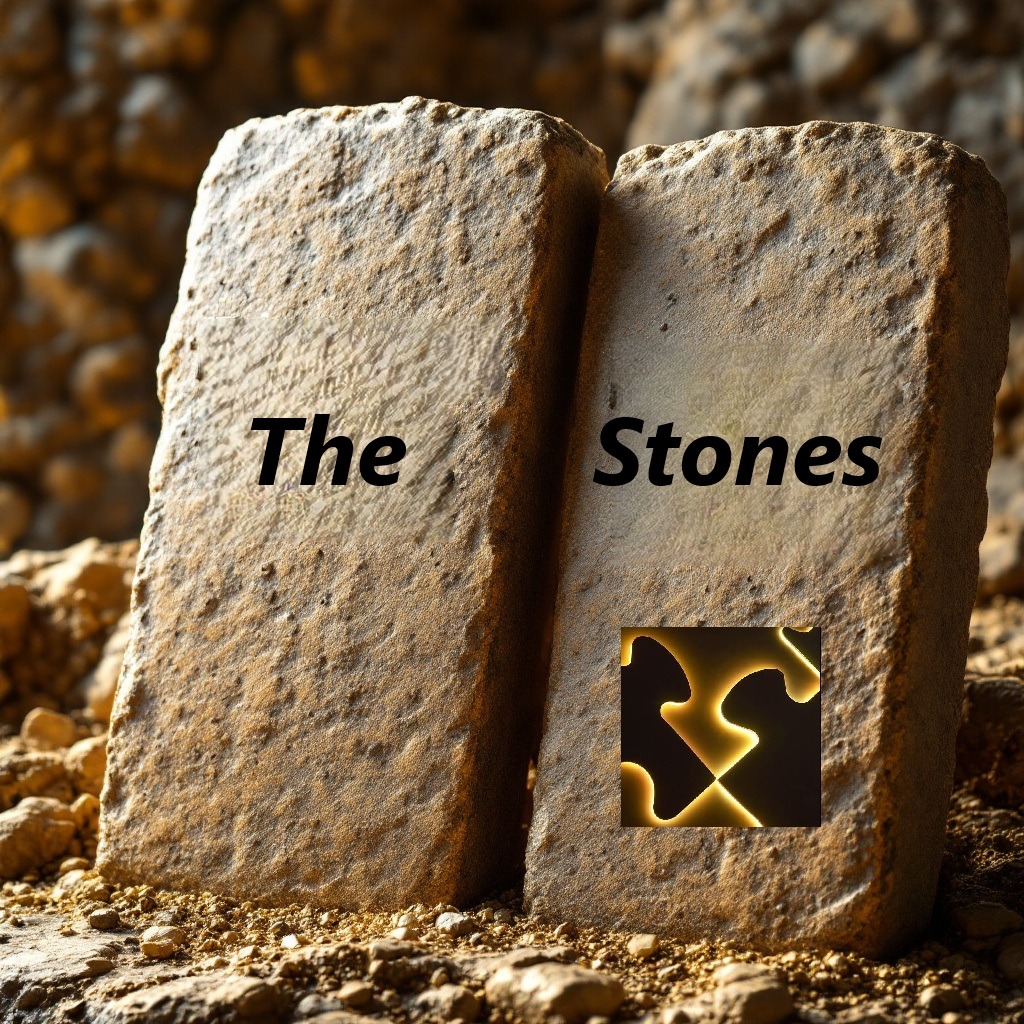

The Stones on Ebal
Welcome back to the Free Thinkers guide to the bible. I created this series so that ‘anyone’ can explore and understand the bible. You don’t need to be a biblical scholar; all you need is a desire to see what is written. I will present to you several biblical examples and demonstrate the process of sifting the accounts to reveal the hidden. This process is very similar to archeology, where the layers are excavated and analyzed.
Just not the dirty part, though you will be digging up some dirt along the way.
The series provides you with numerous examples of two distinct groups of scribal authors/redactors.
The first group is the "A" authors/redactors who focus on priestly matters; laws, rules and observances, as well as the tabernacle/temple services and offerings. The "A" authors and writing styles range from literary artisans to unskilled writers whose works are easily identified.
The second group consists of the “B” and “D” author(s)/redactor(s).
The “D” author/redactor chronicles the first person Moses account of the wilderness travels.
The “B” author(s)/redactor(s) wrote the stories in Genesis; Israel’s time in Egypt and the wilderness travels in Exodus and Numbers.
The “B” wilderness accounts in Exodus and Numbers harmonize with the “D” author’s first person Moses accounts; and is the reason they are grouped together.
In the study we compare the accounts and explore the differences between them to determine why the "A" priestly authors/redactors intentionally created similar yet separate accounts of many of the “B” & “D” author(s)/redactors stories.
*** - Placed where alternate accounts occur or where likely redactor additions occur
And Moses – Text highlighted with this color show redactor additions and portions that are shared by the accounts.
Underlined portions contain clickable links to the associated Freethinkers studies
Great Stones or Whole Stones?
Did Moses command that Great stones or whole stones be erected on Mount Ebal? Or both?
In this study we contrast the “A” and “D” writers accounts regarding the stones that Moses commanded the people to place on Mount Ebal after Israel passed over the Jordan river. The two accounts vary considerably.
It would be beneficial for you to also review the ‘Blessing and Curse’ study as the two are intermingled.
In the “D” account the command was to set up “Great stones” (Ebanim Gedalot) that were to be set up on the Mount, covered with a plaster (seed – coating of lime?) and “The words of the Law” (Ten commands) were to be written on them. (Two large stones?)
H1419 Gadol – ‘Great’ ‘Mighty’ ‘Noble’
Examples:
Jos 10:18 And Joshua said, Roll great stones upon the mouth of the cave, and set men by it for to keep them:
2Ch 26:15 And he made in Jerusalem engines, invented by cunning men, to be on the towers and upon the bulwarks, to shoot arrows and great stones withal. And his name spread far abroad; for he was marvellously helped, till he was strong.
In the “A” account the command was to build an altar of “Whole stones” that were not fashioned with iron (tools) (Ebanim Shlemot) and offer ascension and peace (shalem) offerings upon it.
H8003 Shalem – ‘Full’ ‘Perfect’ ‘Whole’
Examples:
Deu 25:13 Thou shalt not have in thy bag divers weights, a great (Gadol) and a small. 14 Thou shalt not have in thine house divers measures, a great and a small. 15 But thou shalt have a perfect and just weight, a perfect and just measure shalt thou have: that thy days may be lengthened in the land which the LORD thy God giveth thee.
1Ki 6:7 And the House, when it was being built, was built with finished stone made ready beforehand, so that no hammer or chisel or any iron tool was heard in the House while it was being built.
The “D” writer account
(2nd person) Deu 27:1 And Moses with the elders of Israel commanded the people, saying,
(1st person) Keep all the commandments which I command you this day. 2 And it shall be on the day when ye shall pass over Jordan unto the land which the LORD thy God giveth thee, that thou shalt set thee up great stones, and plaister them with plaister: 3 And thou shalt write upon them all the words of this law, when thou art passed over, that thou mayest go in unto the land which the LORD thy God giveth thee, a land that floweth with milk and honey; as the LORD God of thy fathers hath promised thee. 4 Therefore it shall be when ye be gone over Jordan, that ye shall set up these stones, which I command you this day, in mount Ebal, and thou shalt plaister them with plaister. *** 8 And thou shalt write upon the stones all the words of this law very plainly.
Synopsis
The “D” account is straight forward. The people were to set up large stones; cover them and write all the words of the law ‘torah’ (the ten commands) on them (as a memorial?) after they crossed the Jordan river.
The priestly “A” writer account
Deut 11:29 And it shall come to pass, when the LORD thy God hath brought thee in unto the land whither thou goest to possess it, that thou shalt put the blessing upon mount Gerizim, and the curse upon mount Ebal. 30 Are they not on the other side Jordan, by the way where the sun goeth down, in the land of the Canaanites, which dwell in the champaign over against Gilgal, beside the plains of Moreh? ***
Deu 27:5 And there shalt thou build an altar unto the LORD thy God, an altar of stones: thou shalt not lift up any iron tool upon them. 6 Thou shalt build the altar of the LORD thy God of whole stones: and thou shalt offer burnt offerings thereon unto the LORD thy God: 7 And thou shalt offer peace offerings, and shalt eat there, and rejoice before the LORD thy God. ***
Deut 27:9 And Moses and the priests the Levites spake unto all Israel, saying, ***
12 These shall stand upon mount Gerizim to bless the people, when ye are come over Jordan; Simeon, and Levi, and Judah, and Issachar, and Joseph, and Benjamin:
13 And these shall stand upon mount Ebal to curse; Reuben, Gad, and Asher, and Zebulun, Dan, and Naphtali.
14 And the Levites shall speak, and say unto all the men of Israel with a loud voice,
15 Cursed be the man that maketh any graven or molten image, an abomination unto the LORD, the work of the hands of the craftsman, and putteth it in a secret place. And all the people shall answer and say, Amen…
Synopsis
The “A” account begins in chapter eleven stating that blessings and curses were to be performed on Mount Gerizim and Mount Ebal once they crossed the Jordan river. It continues in chapter twenty-seven and adds that the people would also build an altar of ‘whole stones’ and offer olah and shalem offerings and rejoice before the Creator.
The account goes on to add that Moses and the Levite priests spoke to the people regarding the blessings and curses; where they would stand (and what they would speak?). The writer listed the twelve curses that would be spoken by the Levites to the people at the Mounts.
The Joshua account
Joshua 8:30 Then Joshua built an altar unto the LORD God of Israel in mount Ebal, 31 As Moses the servant of the LORD commanded the children of Israel, as it is written in the book of the law of Moses, an altar of whole stones, over which no man hath lift up any iron: and they offered thereon burnt offerings unto the LORD, and sacrificed peace offerings.
32 And he wrote there upon the stones a copy of the law of Moses, which he wrote in the presence of the children of Israel.
33 And all Israel, and their elders, and officers, and their judges, stood on this side the ark and on that side before the priests the Levites, which bare the ark of the covenant of the LORD, as well the stranger, as he that was born among them; half of them over against mount Gerizim, and half of them over against mount Ebal; as Moses the servant of the LORD had commanded before, that they should bless the people of Israel.
34 And afterward he read all the words of the law, the blessings and cursings, according to all that is written in the book of the law. 35 There was not a word of all that Moses commanded, which Joshua read not before all the congregation of Israel, with the women, and the little ones, and the strangers that were conversant among them.
Synopsis
The Joshua account follows the “A” writer’s account in most regards. The altar of ‘whole stones’ was built and they offered burnt offerings and peace offerings upon it. Half of the people were on Mount Gerizim and the other half on Mount Ebal.
Note: There is an inference that the Levite priests were commanded to ‘bless’ the people. Strangely; the text does not state that any blessings and or curses were spoken. We could assume that the Levite priests spoke the words (curses) in (Deut 27:9-26) to the people at that time.
Joshua wrote a copy (Mishneh) of the torah (Ten Commands) on ‘the stones’. The only stones that are mentioned in the account are the ‘Shalem stones’ (small, un-plastered stones) of the altar.
Questions: Are we the reader to assume that the ‘Great stones’ were plastered and prepared for him to write on? Or are we to assume that he wrote the commands on the altar stones?
Joshua then read (called out - Qara) ‘all’ of the words of the ‘Torah’ and the ‘blessings and curses’ to the people.
Question: Why did Joshua read the Torah, blessings and curses to the people at that time? He was not commanded to do so by the Lord or by Moses; and Moses had already spoken ‘those words’ to the people fairly recently.
Whether purposely or unintentionally; The Joshua account is ambiguous and brings several questions to mind and has peculiarities that need to be considered and addressed.
A simple story does not cause the mind to stumble
and seek answers to difficult questions.
Comparison
In the “D” account the stones that were to be set up, plastered and have the torah (Decalogue) were “Great stones” (Ebanim Gedalot). There is no mention of an altar or offerings.
In the “A” and Joshua accounts the stones that were to be used to build the altar were “whole stones” (Ebanim Shlemot) There is no mention of the Decalogue stones.
In the “D” account the “Great stones” were to be erected on Mount Ebal.
In the “A” and Joshua accounts the altar of “whole stones” were erected on Mount Ebal. There is no mention of the Decalogue stones.
In the “D” account there is no mention of the blessings and curses being given at the Mounts.
In the “A” account the blessings and curses were to be given on the Mounts and half of the tribes would stand on each mount. There are twelve specific curses that were to be called out by the Levite priests to the people.
In the Joshua account the tribes stood on each mount. There is no mention of the blessings or curses being given besides when Joshua read the torah, blessings and curses before the people. The twelve specific curses that were to be called out by the Levite priests to the people is not mentioned.
Context comparison
In the “D” account Moses spoke the torah, statutes, judgments, blessings and cursings to the people from the Moabite side of the Jordan River.
In the Joshua account; Joshua read the torah, blessings and curses before the people at Mount Ebal.
Conclusion
You can disregard and or rationalize the differences in the accounts; or based on the evidence presented; you can recognize the possibility that the priestly writers sought to associate the priesthood with the giving of the curses and blessings to the people and created insertions and an alternate event.
I leave this for you to ponder.
All of the material on this site is the product of my twenty-five years of research and study in the fields of Middle Eastern history, archeology (focusing on the Levant), biblical theology, (the study of the Christian, Judaic and Islamic religions), linguistics (I have studied the Hebrew and Greek languages in order to gain the original writers perspectives). I have personal experience with the following faiths: Southern Baptist, WWCG, CGI, Messianic Judaism and Judaism I lived in a torah based monotheist community based on humanist teachings and values for several years. I have been writing studies/articles and parables since the early 2000s. I published many of my works on the www.YHWHisEl.com site at that time; with a focus on monotheism and the non deity of Jesus (Yehoshua).
After identifying many peculiarities in the TaNaKh while teaching, I tasked myself with determining the source of the inconsistencies. I began my search in the first five books of the bible. I read through them many times; locating inconsistencies and attempting to find the golden key that would unlock them. I read many articles, publications and books in which the authors attempted to explain the irregularities (most based on a version of the JDEP theory) and I tested each against the inconsistencies and all of them failed to provide a viable answer. I then used critical thinking and tested potential theories until I finally found the solution that solved every problematic area. The Free thinkers guide to the Bible is the culmination of this process.
I only use AI for images on this site; I did not use AI to reach my conclusions, or use it to write or structure my material.
I do not condone AI scraping or any other form of theft of intellectual property.
If you choose to share the information I present; please be courteous and give credit to this site and myself (the author).
Author: Hoyt Allen Spiker - 2026 - Shemoth20@Gmail.com