
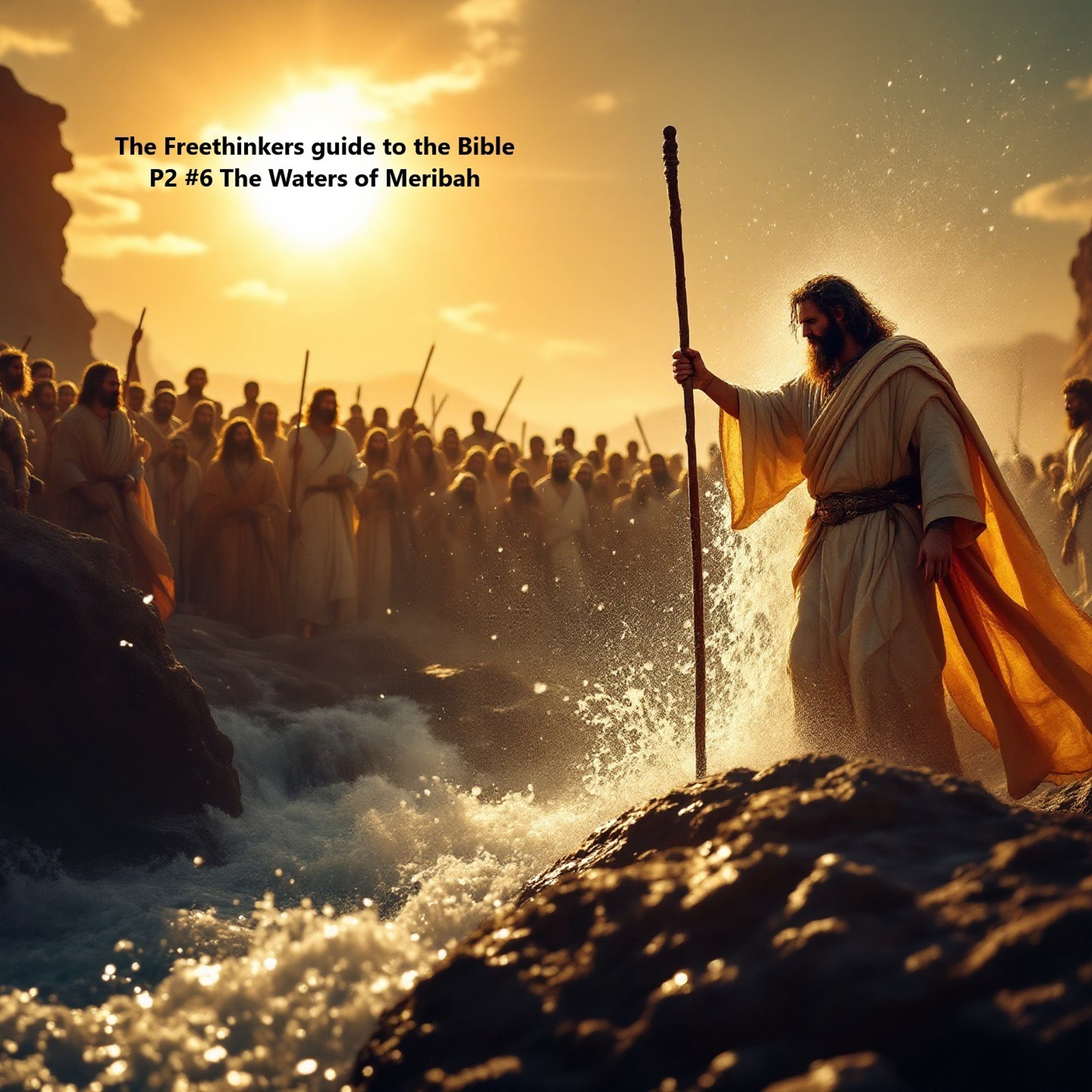

The Free Thinkers guide to the Bible
Part 2 #6 - The Waters of Meribah
Revealing the veiled battle for Authority
Welcome back to the Free Thinkers guide to the bible. I created this series so that ‘anyone’ can explore and understand the bible. You don’t need to be a biblical scholar; all you need is a desire to see what is written. I will present to you several biblical examples and demonstrate the process of sifting the accounts to reveal the hidden. This process is very similar to archeology, where the layers are excavated and analyzed. Just not the dirty part, though you will be digging up some dirt along the way.
Warning:
The series unfolds like a story in a book. Please study the content in the order it is presented in order to have the best experience.
When reading the bible or listening to a Priest, Rabbi or Pastor, have you heard or read contradictions, peculiarities or repetitions that caused your subconscious mind to pause and attempt to reconcile them? Like myself, You may have told yourself “I’m sure there is a reasonable explanation for this”, or “I will look into that later”… more than likely you never got around to it, or decided like the majority of people, that you would trust those with more experience than yourself.
If you are tired of relying on religious authorities to answer the difficult questions with unsatisfying responses that raise more questions than they answer. If you truly seek answers; continue reading the presentations in this series and I will show you how to easily explore the Bible and answer the hard questions yourself.
The series provides you with numerous examples of two distinct groups of scribal authors/redactors.
The first group is the "A" authors/redactors who focus on priestly matters; laws, rules and observances, as well as the tabernacle/temple services and offerings. The "A" authors and writing styles range from literary artisans to unskilled writers whose works are easily identified.
The second group consists of the “B” and “D” author(s)/redactor(s).
The “D” author/redactor chronicles the first person Moses account of the wilderness travels.
The “B” author(s)/redactor(s) wrote the stories in Genesis; Israel’s time in Egypt and the wilderness travels in Exodus and Numbers.
The “B” wilderness accounts harmonize with the “D” author’s first person Moses accounts; and is the reason they are grouped together.
In the study we compare the accounts and explore the differences between them to determine why the "A" priestly authors/redactors intentionally created similar yet separate accounts of many of the “B” author(s)/redactors stories.
In the second part of the series we explore unusual and complex passages that portray Moses and Aaron in diminished or elevated situations. We submit to you that some of these contrasts were deliberately placed in strategic areas to influence the reader.
The Waters of Meribah – Two accounts
Preface
Moses diminished
We return to the “Waters of Meribah” to study a portion of the event that we did not highlight during the first part of the series. In this short observation study we will unveil a diminishment of Moses that is often overlooked or not seen as consequential in one of the events.
One story, two accounts The Waters of Meribah “A”
Num 20: 1 Then came the children of Israel, even the whole congregation, into the desert of Zin in the first month: and the people abode in Kadesh; and Miriam died there, and was buried there. 2 And there was no water for the congregation: and they gathered themselves together against Moses and against Aaron. 3 And the people chode with Moses, and spake, saying, would God that we had died when our brethren died before the LORD! (יהוה) 4 and why have ye brought up the congregation of the LORD (יהוה) into this wilderness, that we and our cattle should die there? 5 And wherefore have ye made us to come up out of Egypt, to bring us in unto this evil place? It is no place of seed, or of figs, or of vines, or of pomegranates; neither is there any water to drink. 6 And Moses and Aaron went from the presence of the assembly unto the door of the tabernacle of the congregation, and they fell upon their faces: and the glory of the LORD (יהוה) appeared unto them.
7 And the LORD (יהוה) spake unto Moses, saying, 8 Take the rod, and gather thou the assembly together, thou, and Aaron thy brother, and speak ye unto the rock before their eyes; and it shall give forth his water, and thou shalt bring forth to them water out of the rock: so thou shalt give the congregation and their beasts drink. 9 And Moses took the rod from before the LORD (יהוה), as he commanded him.
Moses Strikes the Rock
Num 20:10 And Moses and Aaron gathered the congregation together before the rock, and he said unto them, Hear now, ye rebels; must we fetch you water out of this rock? 11 And Moses lifted up his hand, and with his rod he smote the rock twice: and the water came out abundantly, and the congregation drank, and their beasts also. 12 And the LORD (יהוה) spake unto Moses and Aaron, because ye believed me not, to sanctify me in the eyes of the children of Israel, therefore ye shall not bring this congregation into the land which I have given them. 13 This is the water of Meribah; because the children of Israel strove with the LORD (יהוה), and he was sanctified in them.
The reason and the consequences
Moses does not enter the land because of his actions at the waters of Meribah “A” Why is that?
“A” Num 27:12 And the LORD (יהוה) said unto Moses, Get thee up into this mount Abarim, and see the land which I have given unto the children of Israel. 13 And when thou hast seen it, thou also shalt be gathered unto thy people, as Aaron thy brother was gathered. 14 For ye rebelled against my commandment in the desert of Zin, in the strife of the congregation, to sanctify me at the water before their eyes: that is the water of Meribah in Kadesh in the wilderness of Zin.
“A” Deu 32:48 And the LORD (יהוה) spake unto Moses that selfsame day, saying, 49 Get thee up into this mountain Abarim, unto mount Nebo, which is in the land of Moab, that is over against Jericho; and behold the land of Canaan, which I give unto the children of Israel for a possession 50 And die in the mount whither thou goest up, and be gathered unto thy people; as Aaron thy brother died in mount Hor, and was gathered unto his people: 51 Because ye trespassed against me among the children of Israel at the waters of Meribah-Kadesh, in the wilderness of Zin; because ye sanctified me not in the midst of the children of Israel. 52 Yet thou shalt see the land before thee; but thou shalt not go thither unto the land which I give the children of Israel.
We read in both Numbers 27 and in the “A” writers account in Deuteronomy 32 that Moses would not be able to enter the land; and that he would be “gathered” because he “rebelled” against the command of the Creator or he “trespassed” against the Creator. In both accounts it is written that he did not “sanctify” (qâdash - קדשׁ - to make or pronounce something “clean” ceremoniously or morally) the Creator. According to the account, Moses did not follow the instruction to speak to the rock. He struck the rock with the staff.
Psalm 106:32 they angered him (Moses) also at the waters of strife (Meribah), so that it went ill with Moses for their sakes: 33 because they provoked his spirit, so that he spake unadvisedly with his lips.
The writer of the Psalm stated that Moses words were the cause of the rebellion. In verse 10 it states that Moses said “Hear now, ye rebels; must we fetch you water out of this rock?” Was this the reason? Or was it the combination of both?
More food for thought… We continue in Numbers chapter 20 and read the following…
“A” Numbers 20:23 And the LORD (יהוה) spake unto Moses and Aaron in mount Hor, by the coast of the land of Edom, saying, 24 Aaron shall be gathered unto his people: for he shall not enter into the land which I have given unto the children of Israel, because ye rebelled against my word at the water of Meribah.
It appears that the "A" writer is pointing the proverbial finger at Moses for causing the rebellion.
One story, two accounts The Waters of Meribah “B” & "D"
“B” Exo 17:1 And all the congregation of the children of Israel journeyed from the wilderness of Sin, after their journeys, according to the commandment of the LORD (יהוה), and pitched in Rephidim: and there was no water for the people to drink. 2 Wherefore the people did chide with Moses, and said, give us water that we may drink. And Moses said unto them, why chide ye with me? wherefore do ye tempt the LORD? (יהוה) 3 And the people thirsted there for water; and the people murmured against Moses, and said, Wherefore is this that thou hast brought us up out of Egypt, to kill us and our children and our cattle with thirst? 4 And Moses cried unto the LORD (יהוה), saying, what shall I do unto this people? They be almost ready to stone me. 5 And the LORD (יהוה) said unto Moses, Go on before the people, and take with thee of the elders of Israel; and thy rod, wherewith thou smotest the river, take in thine hand, and go. 6 Behold, I will stand before thee there upon the rock in Horeb; and thou shalt smite the rock, and there shall come water out of it, that the people may drink. And Moses did so in the sight of the elders of Israel. 7 And he called the name of the place Massah, and Meribah, because of the chiding of the children of Israel, and because they tempted the LORD (יהוה), saying, Is the LORD (יהוה) among us, or not?
The people complained to Moses and grumbled because they had no water to drink. Moses petitioned the Creator and He gave him instructions on how to bring forth water for the people. Moses did as he was instructed and the people were given the water they complained for.
The name of the location is then called “Massah” (temptation/trial) and “Meribah” (provocation/strife)
There is nothing here referring to a rebellion or trespass by Moses in this account.
What other sources do we have that can explain why Moses does not enter the land?
"D" Deu 3:23 And I (Moses firsthand) besought the LORD (יהוה) at that time, saying, 24 O Lord (Master) GOD (יהוה), thou hast begun to shew thy servant thy greatness, and thy mighty hand: for what God (אל) (El) is there in heaven or in earth, that can do according to thy works, and according to thy might? 25 I pray thee, let me go over (‛âbar-cross over), and see the good land that is beyond Jordan, that goodly mountain, and Lebanon. 26 But the LORD (יהוה) was wroth (‛âbar-angry/cross) with me for your sakes, and would not hear me: and the LORD (יהוה) said unto me, Let it suffice thee; speak no more unto me of this matter. 27 Get thee up into the top of Pisgah, and lift up thine eyes westward, and northward, and southward, and eastward, and behold it with thine eyes: for thou shalt not go over this Jordan.
The firsthand account verse 26 states that the Creator was cross with Moses because of the (grumbling and complaining) of the people.
"D" Deu 4:20 But the LORD (יהוה) hath taken you, and brought you forth out of the iron furnace, even out of Egypt, to be unto him a people of inheritance, as ye are this day. 21 Furthermore the LORD (יהוה) was angry ('ânaph-displeased) with me for your sakes, and sware that I should not go over Jordan, and that I should not go in unto that good land, which the LORD (יהוה) thy God (אלהים) (Elohim) giveth thee for an inheritance: 22 But I must die in this land, I must not go over Jordan: but ye shall go over, and possess that good land.
Once again we read that the Creator was displeased with Moses because of the people.
You have seen two accounts of the same event.
In the “A” account the Creator is angry because Moses didn’t “sanctify” Him; and he and Aaron did not see the land because of this trespass.
In the firsthand “D” account the Creator is displeased with Moses because of the people.
Which is correct? From the knowledge you have gained in the previous studies you should have an a very good educated guess. By the end of the studies you will know for certain.
The elephant in the room...
“A” Deu 32:48 And the LORD (יהוה) spake unto Moses that selfsame day, saying, 49 Get thee up into this mountain Abarim, unto mount Nebo, which is in the land of Moab, that is over against Jericho; and behold the land of Canaan, which I give unto the children of Israel for a possession 50 And die in the mount whither thou goest up, and be gathered unto thy people; as Aaron thy brother died in mount Hor, and was gathered unto his people: 51 Because ye trespassed against me among the children of Israel at the waters of Meribah-Kadesh, in the wilderness of Zin; because ye sanctified me not in the midst of the children of Israel. 52 Yet thou shalt see the land before thee; but thou shalt not go thither unto the land which I give the children of Israel.
Please continue with us in Part three of the series… Moses Vs Moses and Aaron