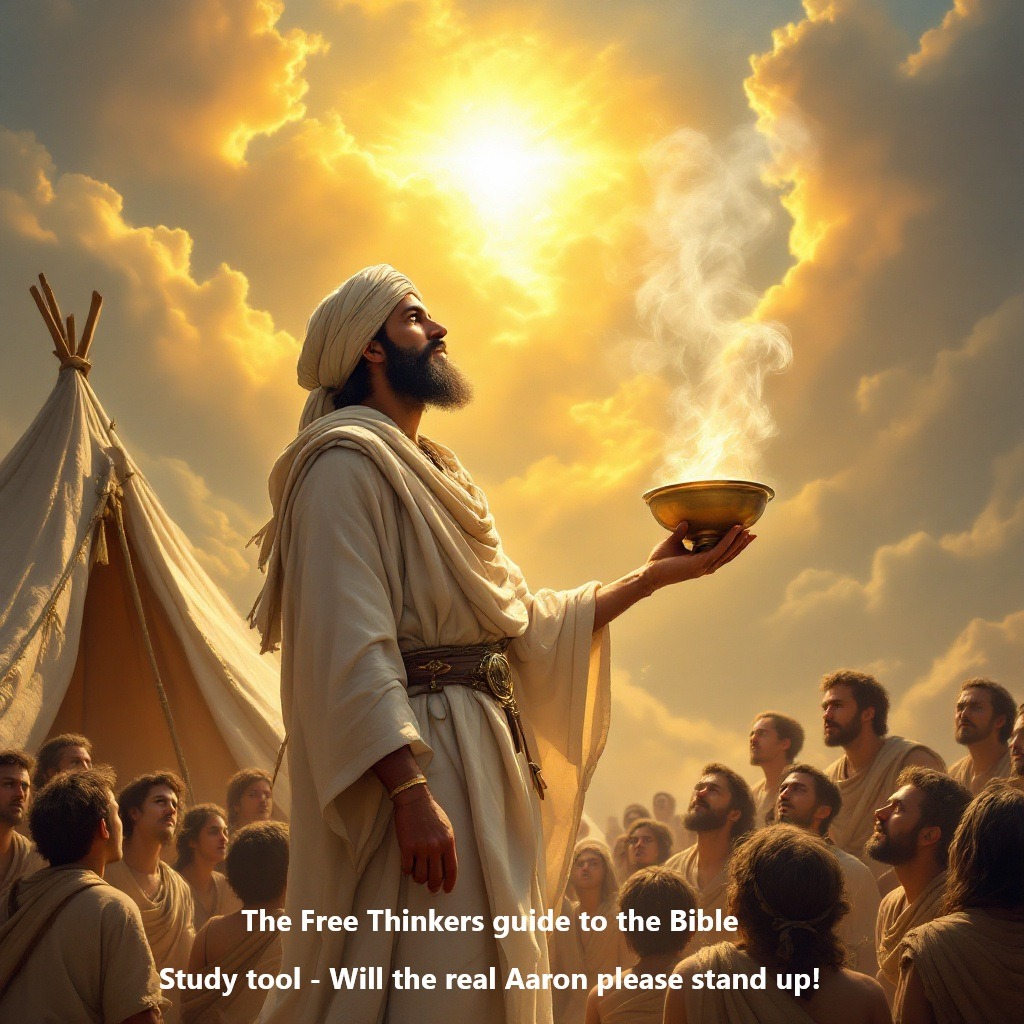
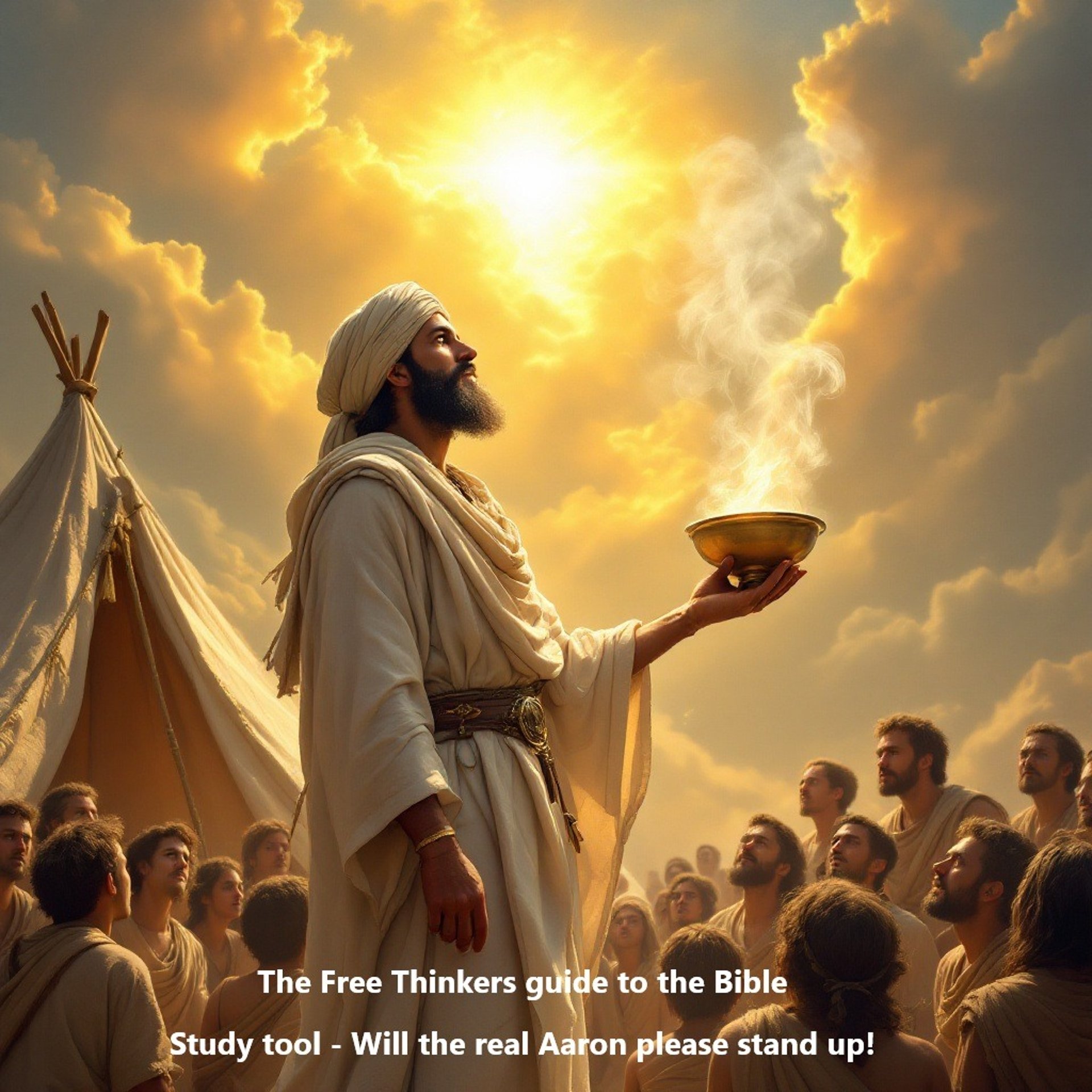

The Free Thinkers guide to the Bible
Part 4 – Aaron; Brother and spokesman of Moses and High Priest of Israel? - Or Israelite leader?
Before we continue In the series I think it will be beneficial to present this study as it gives foundational evidence for the Part four studies.
Warning:
This study will be highly controversial for many readers. The foundation for this study lies in the first three parts of the series. If you have not participated in the foundational studies, please do so before beginning this study.
The Freethinkers guide to the Bible series begins with Part 1 #1 – The Flood
After reading the books of Exodus, Leviticus and Numbers we have a clear picture of Aaron as the brother and right hand man to Moses. We also read the accounts that chronicle the creation of the priesthood and Aaron’s progression into the role of High Priest for the people of Israel.
Aaron’s name occurs almost three hundred times in the three books above. There can be no doubts when it comes to his lineage or authority. No one should have any reason to doubt his pedigree or question his priestly leadership. Right???
Unless you are one of the few who are brave enough to look behind the veil…
If we were to strip away the “A” accounts of Aaron would we find a much different view of Aaron?
Let’s do that! We will focus on the “B” accounts writings to either confirm the popular view, or find that Aaron is not the man we thought him to be.
Will the real Aaron please stand up!
The Plagues “B” – Exodus 6-12
The first mention of Aaron in the “B” accounts is in Exodus six. There are nine likely insertions of Aaron’s name in the ‘Plagues’ account. These occurrences overwhelmingly correspond with the times Moses is called to be the presence of/or is present with Pharaoh. Otherwise there is no mention of Aaron in the “B” Plagues account.
Note: If you have not read ‘the Plagues’ account study, please do so in order to have proper context for our assertions.
Our next “B” account that speaks of Aaron is in Exodus seventeen. Immediately after the “B” ‘The Waters of Meribah’ account. I place the account here for reference since it is such a short account.
The Waters of Meribah “B”
Exo 17:1 And all the congregation of the children of Israel journeyed from the wilderness of Sin, after their journeys, according to the commandment of the LORD, and pitched in Rephidim: and there was no water for the people to drink. 2 Wherefore the people did chide with Moses, and said, Give us water that we may drink. And Moses said unto them, Why chide ye with me? wherefore do ye tempt the LORD? 3 And the people thirsted there for water; and the people murmured against Moses, and said, Wherefore is this that thou hast brought us up out of Egypt, to kill us and our children and our cattle with thirst? 4 And Moses cried unto the LORD, saying, What shall I do unto this people? they be almost ready to stone me. 5 And the LORD said unto Moses, Go on before the people, and take with thee of the elders of Israel; and thy rod, wherewith thou smotest the river, take in thine hand, and go. 6 Behold, I will stand before thee there upon the rock in Horeb; and thou shalt smite the rock, and there shall come water out of it, that the people may drink. And Moses did so in the sight of the elders of Israel. 7 And he called the name of the place Massah, and Meribah, because of the chiding of the children of Israel, and because they tempted the LORD, saying, Is the LORD among us, or not?
Note: There is no mention of Aaron in this account.
Moses at the battle with Amalek "B"
Exo 17:8 Then came Amalek, and fought with Israel in Rephidim. 9 And Moses said unto Joshua, Choose us out men, and go out, fight with Amalek: tomorrow I will stand on the top of the hill with the rod of God in mine hand. 10 So Joshua did as Moses had said to him, and fought with Amalek: and Moses, Aaron, and Hur went up to the top of the hill. 11 And it came to pass, when Moses held up his hand, that Israel prevailed: and when he let down his hand, Amalek prevailed. 12 But Moses' hands were heavy; and they took a stone, and put it under him, and he sat thereon; and Aaron and Hur stayed up his hands, the one on the one side, and the other on the other side; and his hands were steady until the going down of the sun. 13 And Joshua discomfited Amalek and his people with the edge of the sword. 14 And the LORD said unto Moses, Write this for a memorial in a book, and rehearse it in the ears of Joshua: for I will utterly put out the remembrance of Amalek from under heaven. 15 And Moses built an altar, and called the name of it Jehovahnissi: 16 For he said, Because the LORD hath sworn that the LORD will have war with Amalek from generation to generation.
This is the first time Aaron is mentioned in the “B” accounts; we also see a man we have never heard of named Hur at the same time. This should make you wonder at the coincidence. What is the connection? Let’s explore further… we read that Moses, Aaron and Hur went to the top of a hill to oversee the battle with Amalek. Moses has his staff in his hand. Time passes and Moses’ arms tire and Aaron and Hur help support him. The Israelites defeat Amalek and Moses builds an altar and calls it Jehovahnissi (יהוה is my banner).
Notes: Note the use of the Name of the Creator by the King James Version writers. Also remember the building of this altar as this information will be used in a future study.
We have our next mention of Aaron (and Hur) in chapter twenty-four when the Creator calls Moses up to the Mount.
Note: in the future I will post a study that demonstrates the intermixing of “A” & “B” accounts titled ‘Moses on the Mount’.
Exo 24:12 And the LORD said unto Moses, Come up to me into the mount, and be there: and I will give thee tables of stone, and a law, and commandments which I have written; that thou mayest teach them. 13 And Moses rose up, and his minister Joshua: and Moses went up into the mount of God (אלהים) (Elohim). 14 And he said unto the elders, Tarry ye here for us, until we come again unto you: and, behold, Aaron and Hur are with you: if any man have any matters to do, let him come unto them. 15 And Moses went up into the mount, and a cloud covered the mount. 16 And the glory of the LORD abode upon Mount Sinai, and the cloud covered it six days: and the seventh day he called unto Moses out of the midst of the cloud. 17 And the sight of the glory of the LORD was like devouring fire on the top of the mount in the eyes of the children of Israel. 18 And Moses went into the midst of the cloud, and gat him up into the mount: and Moses was in the mount forty days and forty nights.
In this account we read that Moses told the elders to await his return and to seek the counsel of Aaron and Hur if the need for judgment arose. Moses and Joshua go up to the Mount. This account confirms that Aaron and Hur are leaders among the people and are respected enough that they are left in charge in his absence. If we apply this to the first occurrence of Aaron and Hur we realize that these men are leaders of esteem amongst the people and Moses trusted them at the battle of Amalek to support him.
Our next “B” account that features Aaron is the well known Golden calf incident. This occurs directly after the chapter twenty-four ‘Moses on the Mount’ account.
You are not supposed to notice or care, but the two uninterrupted accounts are separated by seven chapters that the “A” writer(s) inserted between them. These chapters are focused on priestly items. i.e. The Ark of the covenant, the Tabernacle of the congregation, the table of shew bread, the golden lamp stand, the bronze altar, the incense altar, the bronze basin, the anointing oil, incense and the priests garments. These chapters contain the first references to most or all of these items and leads with the Creator telling Moses to speak to the people and ask them to offer the materials to build the objects. We then read the instructions for the construction of the various items. Chapter twenty-eight confirms that Aaron and his sons would be the High Priests that would minister to the Creator. Instructions are also given for the consecration of the priests.
Note: Remember to look for insertions while studying; you will find that the insertion of priestly matters is prevalent in Exodus, Numbers and to a lesser extent in Deuteronomy.
Let’s pause here and examine this insertion between the two “B” accounts. We really need to put the magnifying glass to this because it is one of the best examples of the “A” writer(s) handiwork. Just to make sure we are on the same page I will place the final verse of the previous “B” account and place the first verse of the Golden calf directly after.
Exodus 24:18 And Moses went into the midst of the cloud, and gat him up into the mount: and Moses was in the mount forty days and forty nights. Exodus 32:1 And when the people saw that Moses delayed to come down out of the mount, the people gathered themselves together unto Aaron, and said unto him, Up, make us gods, which shall go before us; for as for this Moses, the man that brought us up out of the land of Egypt, we wot not what is become of him.
Do we just ignore the fact that seven chapters concerning every major ceremonial object, ritual and garment have been inserted between the time Moses went up to the Mount and his return? It’s a good thing Joshua was with Moses. With the amount of instructions that needed to be inscribed, we can only imagine how many scrolls of parchment Joshua would need to carry up the mountain for Moses to inscribe the instructions and diagrams on! I guess we now know why they were on the mount for forty days! Or… maybe Moses had a photographic memory.
Exo_25:40 And look that thou make them after their pattern, which was shewed thee in the mount.
Exo_26:30 And thou shalt rear up the tabernacle according to the fashion thereof which was shewed thee in the mount.
Exo_27:8 Hollow with boards shalt thou make it: as it was shewed thee in the mount, so shall they make it.
With all seriousness, we really need to be circumspect about this matter; especially after we read the Golden calf account.
The Golden/Molten Calf “B”
Exo 32:1 And when the people saw that Moses delayed to come down out of the mount, the people gathered themselves together unto Aaron, and said unto him, Up, make us gods (אלהים) (Elohim), which shall go before us; for as for this Moses, the man that brought us up out of the land of Egypt, we wot not what is become of him. 2 And Aaron said unto them, Break off the golden earrings, which are in the ears of your wives, of your sons, and of your daughters, and bring them unto me.
3 And all the people brake off the golden earrings which were in their ears, and brought them unto Aaron. 4 And he received them at their hand, and fashioned it with a graving tool, after he had made it a molten calf: and they said, these be thy gods (אלהים) (Elohim), O Israel, which brought thee up out of the land of Egypt. 5 And when Aaron saw it, he built an altar before it; and Aaron made proclamation, and said, tomorrow is a feast to the LORD. 6 And they rose up early on the morrow, and offered burnt offerings, and brought peace offerings;
We read that the people go to Aaron who was left in charge and ask him to make mighty one(s) to lead them. The people refer to Moses’ as “the man” that brought us out of Egypt not “your brother” who brought us out of Egypt. Aaron told the people to bring him their golden ear rings, he took them and melted them and fashioned it/them with an engraving tool to resemble a calf. He then built an altar and told the people that the next day would be a feast/festival to the Lord יהוה. The people make offerings on the altar Aaron made and had a festival to the golden idol (their new mighty one).
Note: This appears to be the first example of idolatry and Aaron could possibly have stopped it by calming the people and assuring them that Moses would return.
7 And the LORD said unto Moses, Go, get thee down; for thy people, which thou broughtest out of the land of Egypt, have corrupted themselves: 8 They have turned aside quickly out of the way which I commanded them: they have made them a molten calf, and have worshipped it, and have sacrificed thereunto, and said, These be thy gods, O Israel, which have brought thee up out of the land of Egypt. 15 And Moses turned, and went down from the mount, and the two tables of the testimony were in his hand: the tables were written on both their sides; on the one side and on the other were they written. 16 And the tables were the work of God, and the writing was the writing of God, graven upon the tables.
17 And when Joshua heard the noise of the people as they shouted, he said unto Moses, There is a noise of war in the camp. 18 And he said, It is not the voice of them that shout for mastery, neither is it the voice of them that cry for being overcome: but the noise of them that sing do I hear.
19 And it came to pass, as soon as he came nigh unto the camp, that he saw the calf, and the dancing: and Moses' anger waxed hot, and he cast the tables out of his hands, and brake them beneath the mount. 20 And he took the calf which they had made, and burnt it in the fire, and ground it to powder, and strawed it upon the water, and made the children of Israel drink of it.
21 And Moses said unto Aaron, What did this people unto thee, that thou hast brought so great a sin upon them? 22 And Aaron said, let not the anger of my lord wax hot: thou knowest the people, that they are set on mischief. 23 For they said unto me, make us gods (אלהים) (Elohim), which shall go before us: for as for this Moses, the man that brought us up out of the land of Egypt, we wot not what is become of him. 24 And I said unto them, whosoever hath any gold, let them break it off. So they gave it me: then I cast it into the fire, and there came out this calf.
Moses confronted Aaron regarding his actions and Aaron blamed the people for pressuring him into making them an idol.
Flesh from Heaven “B”
Numbers 11 Note: There is no mention of Aaron in this account.
Our next mention of Aaron in the “B” accounts is in Numbers twelve…
Miriam and Aaron Oppose Moses “B”
Num 12:1 And Miriam and Aaron spake against Moses because of the Ethiopian woman whom he had married: for he had married an Ethiopian woman. 2 And they said, Hath the LORD indeed spoken only by Moses? hath he not spoken also by us? And the LORD heard it.
3 (Now the man Moses was very meek, above all the men which were upon the face of the earth.)
4 And the LORD spake suddenly unto Moses, and unto Aaron, and unto Miriam, Come out ye three unto the tabernacle of the congregation. And they three came out. 5 And the LORD came down in the pillar of the cloud, and stood in the door of the tabernacle, and called Aaron and Miriam: and they both came forth. 6 And he said, hear now my words: If there be a prophet among you, I the LORD will make myself known unto him in a vision, and will speak unto him in a dream.
7 My servant Moses is not so, who is faithful in all mine house. 8 With him will I speak mouth to mouth, even apparently, and not in dark speeches; and the similitude of the LORD shall he behold: wherefore then were ye not afraid to speak against my servant Moses? 9 And the anger of the LORD was kindled against them; and he departed.
10 And the cloud departed from off the tabernacle; and, behold, Miriam became leprous, white as snow: and Aaron looked upon Miriam, and, behold, she was leprous.
11 And Aaron said unto Moses, Alas, my lord, I beseech thee, lay not the sin upon us, wherein we have done foolishly, and wherein we have sinned. 12 Let her not be as one dead, of whom the flesh is half consumed when he cometh out of his mother's womb.
13 And Moses cried unto the LORD, saying, Heal her now, O God, I beseech thee. 14 And the LORD said unto Moses, If her father had but spit in her face, should she not be ashamed seven days? let her be shut out from the camp seven days, and after that let her be received in again.
15 And Miriam was shut out from the camp seven days: and the people journeyed not till Miriam was brought in again.
Aaron and his sister Miriam spoke against Moses’ wife and also against his authority as spokesman for the Creator. Miriam is plagued with leprosy for her part in the rebellion. There are no consequences for Aaron written regarding his part in the rebellion beyond an admonishment from the Creator.
The Spies “B”
Numbers 13-14 Note: There is no mention of Aaron in this account.
The Rebellion of Dathan, Abiram “B”
Numbers 16 Note: There is no mention of Aaron in this account.
The heresy of Ba’al Peor “B”
Numbers 25 Note: There is no mention of Aaron in this account.
We will now review the four times that Aaron is mentioned in the scroll of Deuteronomy.
The Golden/Molten Calf “D”
Deu 9:8 Also in Horeb ye provoked the LORD to wrath, so that the LORD was angry with you to have destroyed you. 9 When I was gone up into the mount to receive the tables of stone, even the tables of the covenant which the LORD made with you, then I abode in the mount forty days and forty nights, I neither did eat bread nor drink water: 10 And the LORD delivered unto me two tables of stone written with the finger of God; and on them was written according to all the words, which the LORD spake with you in the mount out of the midst of the fire in the day of the assembly. 11 And it came to pass at the end of forty days and forty nights, that the LORD gave me the two tables of stone, even the tables of the covenant.
12 And the LORD said unto me, Arise, get thee down quickly from hence; for thy people which thou hast brought forth out of Egypt have corrupted themselves; they are quickly turned aside out of the way which I commanded them; they have made them a molten image. 13 Furthermore the LORD spake unto me, saying, I have seen this people, and, behold, it is a stiffnecked people: 14 Let me alone, that I may destroy them, and blot out their name from under heaven: and I will make of thee a nation mightier and greater than they.
15 So I turned and came down from the mount, and the mount burned with fire: and the two tables of the covenant were in my two hands. 16 And I looked, and, behold, ye had sinned against the LORD your God, and had made you a molten calf: ye had turned aside quickly out of the way which the LORD had commanded you. 17 And I took the two tables, and cast them out of my two hands, and brake them before your eyes. 18 And I fell down before the LORD, as at the first, forty days and forty nights: I did neither eat bread, nor drink water, because of all your sins which ye sinned, in doing wickedly in the sight of the LORD, to provoke him to anger. 19 For I was afraid of the anger and hot displeasure, wherewith the LORD was wroth against you to destroy you. But the LORD hearkened unto me at that time also. 20 And the LORD was very angry with Aaron to have destroyed him: and I prayed for Aaron also the same time. 21 And I took your sin, the calf which ye had made, and burnt it with fire, and stamped it, and ground it very small, even until it was as small as dust: and I cast the dust thereof into the brook that descended out of the mount.
In this first person “D” account Moses recounts the Golden calf incident. He refers to Aaron two times. They are both regarding Moses’ petition to the Creator to spare Aaron’s life for his part in the creation of the Golden Calf.
Moses on the Mount
Deu 10:3 And I made an ark of shittim wood, and hewed two tables of stone like unto the first, and went up into the mount, having the two tables in mine hand. 4 And he wrote on the tables, according to the first writing, the Ten Commandments, which the LORD spake unto you in the mount out of the midst of the fire in the day of the assembly: and the LORD gave them unto me. 5 And I turned myself and came down from the mount, and put the tables in the ark which I had made; and there they be, as the LORD commanded me. 6 And the children of Israel took their journey from Beeroth of the children of Jaakan to Mosera: there Aaron died, and there he was buried; and Eleazar his son ministered in the priest's office in his stead. 7 From thence they journeyed unto Gudgodah; and from Gudgodah to Jotbath, a land of rivers of waters. 8 At that time the LORD separated the tribe of Levi, to bear the ark of the covenant of the LORD, to stand before the LORD to minister unto him, and to bless in his name, unto this day. 9 Wherefore Levi hath no part nor inheritance with his brethren; the LORD is his inheritance, according as the LORD thy God promised him. 10 And I stayed in the mount, according to the first time, forty days and forty nights; and the LORD hearkened unto me at that time also, and the LORD would not destroy thee. 11 And the LORD said unto me, Arise, take thy journey before the people, that they may go in and possess the land, which I sware unto their fathers to give unto them.
You should notice when you read this portion that the account doesn’t flow smoothly. Read the account a few times and try to identify the verses that are causing the account to seem fractured.
The “D” account with the likely Insertion removed:
Deu 10:1 At that time the LORD said unto me, Hew thee two tables of stone like unto the first, and come up unto me into the mount, and make thee an ark of wood. 2 And I will write on the tables the words that were in the first tables which thou brakest, and thou shalt put them in the ark. 3 And I made an ark of shittim wood, and hewed two tables of stone like unto the first, and went up into the mount, having the two tables in mine hand. 4 And he wrote on the tables, according to the first writing, the Ten Commandments, which the LORD spake unto you in the mount out of the midst of the fire in the day of the assembly: and the LORD gave them unto me. 5 And I turned myself and came down from the mount, and put the tables in the ark which I had made; and there they be, as the LORD commanded me. *** 10 And I stayed in the mount, according to the first time, forty days and forty nights; and the LORD hearkened unto me at that time also, and the LORD would not destroy thee. 11 And the LORD said unto me, Arise, take thy journey before the people, that they may go in and possess the land, which I sware unto their fathers to give unto them.
Without the journey, the death of Aaron and the priestly insertions, the account flows smoothly.
*** The likely Insertion:
6 And the children of Israel took their journey from Beeroth of the children of Jaakan to Mosera: there Aaron died, and there he was buried; and Eleazar his son ministered in the priest's office in his stead. 7 From thence they journeyed unto Gudgodah; and from Gudgodah to Jotbath, a land of rivers of waters. 8 At that time the LORD separated the tribe of Levi, to bear the ark of the covenant of the LORD, to stand before the LORD to minister unto him, and to bless in his name, unto this day. 9 Wherefore Levi hath no part nor inheritance with his brethren; the LORD is his inheritance, according as the LORD thy God promised him.
These additions were strategically placed in the midst of the account by a scribe(s) to present information that the “A” writer(s) focus on.
Let’s look at the fourth and last occurrence in Deuteronomy where Aaron is mentioned …
Likely “A” writer insertion:
Deu 32:48 And the LORD spake unto Moses that selfsame day, saying, 49 Get thee up into this mountain Abarim, unto mount Nebo, which is in the land of Moab, that is over against Jericho; and behold the land of Canaan, which I give unto the children of Israel for a possession: 50 And die in the mount whither thou goest up, and be gathered unto thy people; as Aaron thy brother died in mount Hor, and was gathered unto his people: 51 Because ye trespassed against me among the children of Israel at the waters of Meribah-Kadesh, in the wilderness of Zin; because ye sanctified me not in the midst of the children of Israel. 52 Yet thou shalt see the land before thee; but thou shalt not go thither unto the land which I give the children of Israel.
This reading bears an uncanny resemblance to the “A” The Waters of Meribah account…
Moses Strikes the Rock "A"
Num 20:10 And Moses and Aaron gathered the congregation together before the rock, and he said unto them, Hear now, ye rebels; must we fetch you water out of this rock? 11 And Moses lifted up his hand, and with his rod he smote the rock twice: and the water came out abundantly, and the congregation drank, and their beasts also. 12 And the LORD (יהוה) spake unto Moses and Aaron, because ye believed me not, to sanctify me in the eyes of the children of Israel, therefore ye shall not bring this congregation into the land which I have given them. 13 This is the water of Meribah; because the children of Israel strove with the LORD (יהוה), and he was sanctified in them.
We need to contrast this with the firsthand accounts that speak to the reason Moses does not enter the land…
Deu 3:23 And I (Moses firsthand) besought the LORD (יהוה) at that time, saying, 24 O Lord (Master) GOD (יהוה), thou hast begun to shew thy servant thy greatness, and thy mighty hand: for what God (אל) (El) is there in heaven or in earth, that can do according to thy works, and according to thy might? 25 I pray thee, let me go over (‛âbar-cross over), and see the good land that is beyond Jordan, that goodly mountain, and Lebanon. 26 But the LORD (יהוה) was wroth (‛âbar-angry/cross) with me for your sakes, and would not hear me: and the LORD (יהוה) said unto me, Let it suffice thee; speak no more unto me of this matter. 27 Get thee up into the top of Pisgah, and lift up thine eyes westward, and northward, and southward, and eastward, and behold it with thine eyes: for thou shalt not go over this Jordan.
The firsthand account in verse twenty-six states that the Creator was cross with Moses because of the (grumbling and complaining) of the people. There is no mention of not “sanctifying” the Creator.
Deu 4:20 But the LORD (יהוה) hath taken you, and brought you forth out of the iron furnace, even out of Egypt, to be unto him a people of inheritance, as ye are this day. 21 Furthermore the LORD (יהוה) was angry ('ânaph-displeased) with me for your sakes, and sware that I should not go over Jordan, and that I should not go in unto that good land, which the LORD (יהוה) thy God (אלהים) (Elohim) giveth thee for an inheritance: 22 But I must die in this land, I must not go over Jordan: but ye shall go over, and possess that good land.
Once again we read in a firsthand account that the Creator was angry with Moses because of the actions and words of the people. Once again there is no mention of not “sanctifying” the Creator being the cause.
Summary
Aaron’s name appears in the following “B” accounts:
The Plagues “B” – 9X nine likely insertions
8:8 Then Pharaoh called for Moses and Aaron
8:12 And Moses and Aaron went out from Pharaoh
8:25 And Pharaoh called for Moses and for Aaron,
9:27 And Pharaoh sent, and called for Moses and Aaron
10:3 And Moses and Aaron came in unto Pharaoh
10:8 And Moses and Aaron were brought again unto Pharaoh
10:16 Then Pharaoh called for Moses and Aaron
11:10 And Moses and Aaron did all these wonders before Pharaoh
12:30 And Pharaoh rose up in the night, he, and all his servants, and all the Egyptians; and there was a great cry in Egypt; for there was not a house where there was not one dead. 31 And he called for Moses and Aaron
Note: All of the likely insertions occur when Moses is (called to be) in the presence of Pharaoh.
Moses at the battle with Amalek “B” – 2X Aaron and Hur assist Moses
Moses on the Mount “B” – 1X Aaron and Hur lead the people of Israel in Moses absence
The Golden/Molten Calf “B” – 7X Aaron creates a golden calf at the request of the people
Miriam and Aaron Oppose Moses “B” – 5X Aaron and Miriam rebel against the leadership of Moses
Aaron’s name does not appear in the following “B” accounts:
The Waters of Meribah “B”
Flesh from Heaven “B”
The Spies “B”
The Rebellion of Dathan, Abiram “B”
The heresy of Ba’al Peor “B”
Aaron is seen as a leader of the people in the “B” accounts. Moses trusts him and Hur to lead in his absence. He assisted Moses at the battle with Amalek and led the people while he was on the Mount.
Aaron did not hold up to the pressure of leadership while Moses was away for a long period of time. The people came to him and insisted he make them a mighty one (Idol) that would go before them and he did. After this event he and Miriam confronted Moses and stated that they could serve as leaders as well.
Aaron doesn’t appear in any more “B” accounts after this.
In the firsthand Deuteronomy writings; Aaron only appears in the Golden calf account summary.
Please ponder, contemplate and review the information I have presented. It is a very bitter pill that I ask you to swallow. But it is crucial information if you wish to see behind the veil.
I can’t stress this enough… The Freethinkers study must be read in the order it is presented in order to get the complete picture. If you don’t; you may miss critical information.
Please continue the study with...
All of the material on this site is the product of my twenty-five years of research and study in the fields of Middle Eastern history, archeology (focusing on the Levant), biblical theology, (the study of the Christian, Judaic and Islamic religions), linguistics (I have studied the Hebrew and Greek languages in order to gain the original writers perspectives). I have personal experience with the following faiths: Southern Baptist, WWCG, CGI, Messianic Judaism and Judaism I lived in a torah based monotheist community based on humanist teachings and values for several years. I have been writing studies/articles and parables since the early 2000s. I published many of my works on the www.YHWHisEl.com site at that time; with a focus on monotheism and the non deity of Jesus (Yehoshua).
After identifying many peculiarities in the TaNaKh while teaching, I tasked myself with determining the source of the inconsistencies. I began my search in the first five books of the bible. I read through them many times, locating inconsistencies and attempting to find the golden key that would unlock them. I read many articles, publications and books in which the authors attempted to explain the irregularities (most based on a version of the JDEP theory) and I tested each against the inconsistencies and all of them failed to provide a viable answer.
I then used critical thinking and tested potential theories until I finally found the solution that solved every problematic area. The Free thinkers guide to the Bible is the culmination of this process.
I only use AI for images on this site; I did not use it to reach my conclusion and I do not use it to write or structure my material. I do not condone AI scraping or any other form of theft of intellectual property.
If you choose to share the information I present; please be courteous and give credit to this site and myself (the author).
Author: Hoyt Allen Spiker - 2024 - Shemoth20@Gmail.com